
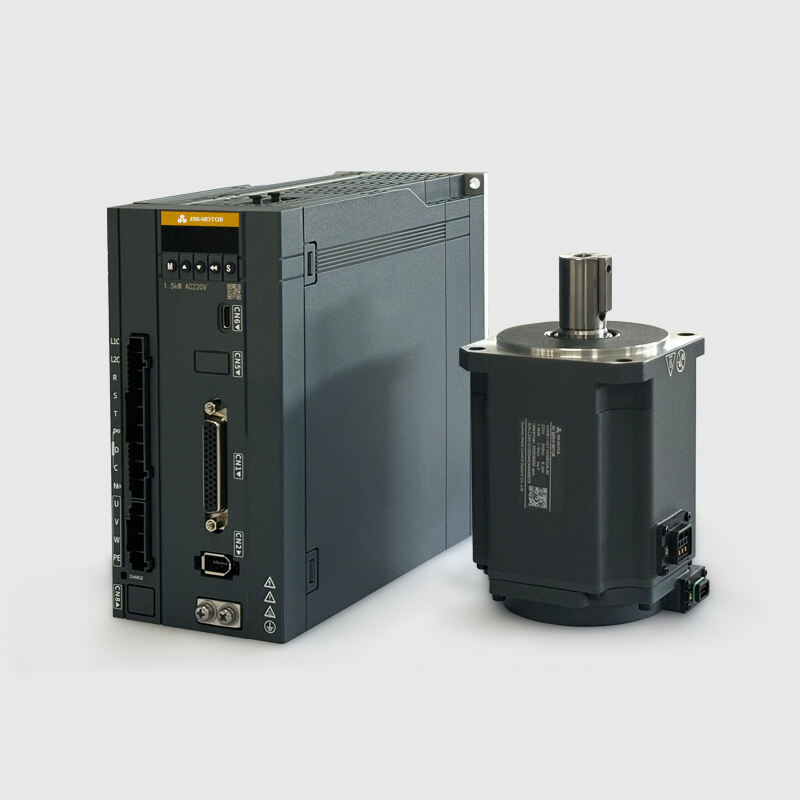
Motion stability in automated systems depends heavily on precise feedback mechanisms that continuously monitor and adjust motor performance. An ac servo motor achieves exceptional motion stability through its sophisticated feedback control system, which creates a closed-loop environment where position, velocity, and torque are constantly monitored and corrected. This feedback-driven approach enables the ac servo motor to maintain consistent performance even when external disturbances or load variations occur during operation.
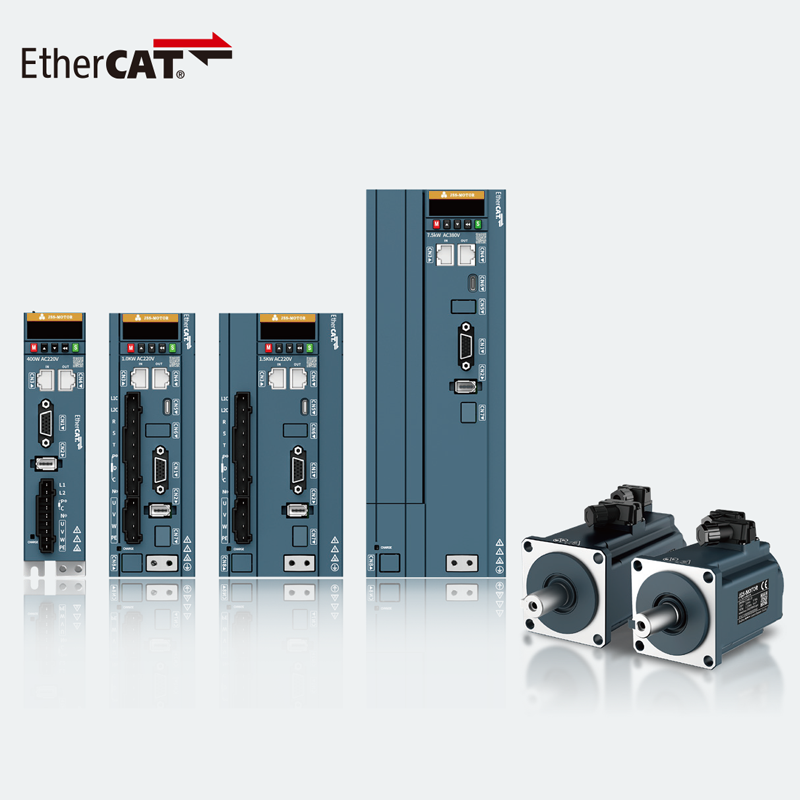
The feedback system in an ac servo motor creates a fundamental difference between servo-controlled motion and traditional motor control methods. While standard motors operate in an open-loop configuration without position verification, the ac servo motor continuously compares actual position with commanded position, generating corrective signals that eliminate positioning errors before they affect system performance. This real-time feedback mechanism transforms the ac servo motor into a highly responsive and stable motion control solution.
Closed-Loop Control Architecture in AC Servo Motors
Fundamental Feedback Loop Components
The closed-loop control architecture of an ac servo motor consists of several interconnected components that work together to maintain motion stability. The servo drive receives position commands from the control system and compares these with actual position feedback from the encoder. This comparison generates an error signal that drives the control algorithm to produce appropriate corrective actions. The ac servo motor responds to these corrections instantaneously, creating a continuous cycle of monitoring and adjustment.
Position feedback represents the primary stabilizing force in ac servo motor systems. High-resolution encoders attached to the motor shaft provide precise position information back to the servo drive, enabling position accuracy typically within micrometers. This feedback mechanism allows the ac servo motor to detect even minute deviations from the commanded position and implement immediate corrections before positioning errors accumulate.
Velocity feedback adds another layer of stability control by monitoring the rate of motion change. The ac servo motor control system calculates velocity from position feedback data and compares it with commanded velocity profiles. This velocity feedback enables smooth acceleration and deceleration curves while preventing overshoot conditions that could destabilize the motion system.
Error Detection and Correction Mechanisms
Error detection in ac servo motor systems operates on multiple levels, creating comprehensive stability monitoring. Position errors are detected by comparing encoder feedback with commanded positions, while velocity errors are identified through derivative calculations of position changes over time. The ac servo motor control system processes these errors through sophisticated algorithms that determine appropriate corrective responses based on system dynamics and performance requirements.
Correction mechanisms in ac servo motor systems utilize proportional-integral-derivative control strategies to eliminate detected errors efficiently. The proportional component provides immediate response to current errors, while the integral component addresses accumulated errors over time, and the derivative component anticipates future error trends. This comprehensive approach enables the ac servo motor to maintain stable motion even under varying load conditions and external disturbances.
Real-time error correction in ac servo motor systems happens within microseconds of error detection, preventing small deviations from developing into significant stability problems. The high-speed processing capabilities of modern servo drives enable continuous monitoring and adjustment cycles that maintain motion stability across diverse operating conditions and application requirements.
Encoder Technology and Precision Feedback
High-Resolution Position Monitoring
Modern ac servo motor systems employ high-resolution encoders that provide exceptional position feedback precision. Optical encoders with resolution capabilities exceeding 20 bits per revolution enable the ac servo motor to detect positional changes as small as fractions of arc-seconds. This ultra-high resolution feedback creates the foundation for stable motion control by ensuring that even microscopic positioning errors are detected and corrected immediately.
Absolute encoders in ac servo motor applications provide position information without requiring reference point establishment, eliminating the positioning uncertainty that occurs during system startup. These encoders maintain position knowledge even during power interruptions, enabling the ac servo motor to resume operation immediately upon power restoration without requiring homing sequences that could introduce temporary instability.
Multi-turn absolute encoders extend position monitoring beyond single revolution limits, providing continuous position tracking across unlimited rotational ranges. This capability enables ac servo motor systems to maintain position stability during extended motion sequences without accumulating positioning errors that could compromise long-term motion accuracy and system stability.
Velocity and Acceleration Feedback Processing
Velocity feedback in ac servo motor systems is derived from high-frequency position sampling that enables precise motion rate monitoring. Digital signal processing algorithms calculate instantaneous velocity by analyzing position changes over extremely short time intervals, providing the ac servo motor control system with accurate velocity information for stability maintenance. This real-time velocity monitoring enables smooth motion profiles that prevent mechanical resonance and vibration issues.
Acceleration feedback adds predictive stability control to ac servo motor systems by monitoring rate-of-change in velocity parameters. The control system analyzes acceleration patterns to anticipate potential stability issues before they manifest as motion disturbances. This predictive capability enables the ac servo motor to implement preemptive corrections that maintain smooth motion even during rapid direction changes and complex motion profiles.
Advanced filtering techniques in ac servo motor feedback systems eliminate noise and interference from encoder signals while preserving critical motion information. Digital filters process raw encoder data to extract clean position, velocity, and acceleration signals that enable precise control responses. This signal conditioning ensures that the ac servo motor receives accurate feedback information for optimal stability performance.
Dynamic Response and Disturbance Rejection
Load Variation Compensation
Load variation compensation represents a critical stability function in ac servo motor applications where external forces change during operation. The feedback system continuously monitors motor current and torque output to detect load changes and automatically adjusts control parameters to maintain motion stability. This adaptive response enables the ac servo motor to handle varying loads without compromising positioning accuracy or motion smoothness.
Torque feedback in ac servo motor systems provides immediate indication of load variations through current monitoring in the motor windings. Changes in load requirements are reflected as current variations that the control system interprets as feedback signals for stability adjustment. The ac servo motor responds to these torque feedback signals by modifying its output characteristics to compensate for changing load conditions while maintaining commanded motion profiles.
Adaptive control algorithms in ac servo motor systems automatically adjust control parameters based on detected load variations and system response characteristics. These algorithms continuously optimize control gains and filtering parameters to maintain stability margins across diverse operating conditions. The ac servo motor benefits from this adaptive approach through consistent performance regardless of load variations or changing application requirements.
External Disturbance Suppression
External disturbance suppression in ac servo motor systems relies on rapid feedback response to counteract unwanted forces or vibrations that could affect motion stability. The high-bandwidth feedback system detects disturbances within milliseconds and generates corrective signals that neutralize their effects before they can influence system performance. This disturbance rejection capability enables the ac servo motor to maintain precise motion control even in challenging industrial environments.
Frequency response analysis in ac servo motor feedback systems identifies potential resonance points and vibration sources that could compromise stability. The control system implements notch filters and gain adjustments at specific frequencies to suppress problematic vibrations while maintaining overall system responsiveness. This frequency-domain approach enables the ac servo motor to operate stably across a wide range of mechanical configurations and mounting conditions.
Predictive disturbance compensation in advanced ac servo motor systems analyzes motion patterns and system responses to anticipate potential stability challenges. Machine learning algorithms can identify recurring disturbance patterns and implement preemptive corrections that minimize their impact on motion stability. This intelligent approach enables the ac servo motor to achieve superior performance in complex applications with predictable disturbance sources.
Performance Optimization Through Feedback Tuning
Control Parameter Adjustment
Control parameter optimization in ac servo motor systems involves careful adjustment of proportional, integral, and derivative gains to achieve optimal stability and responsiveness. The feedback system provides the data necessary for determining appropriate control parameters based on actual system response characteristics. Proper tuning enables the ac servo motor to achieve fast response times while maintaining stability margins that prevent oscillation or overshoot conditions.
Bandwidth optimization in ac servo motor feedback systems balances responsiveness against stability by adjusting the frequency response characteristics of the control loop. Higher bandwidth settings enable faster response to command changes and better disturbance rejection, while lower bandwidth settings provide greater stability margins and reduced sensitivity to noise. The ac servo motor achieves optimal performance through careful bandwidth selection based on application requirements and mechanical system characteristics.
Gain scheduling techniques in ac servo motor systems automatically adjust control parameters based on operating conditions such as velocity, acceleration, or load levels. This adaptive approach enables the ac servo motor to maintain optimal stability and performance across diverse operating ranges without requiring manual parameter adjustments. The feedback system provides the operational data necessary for implementing effective gain scheduling strategies.
System Identification and Optimization
System identification processes in ac servo motor applications analyze feedback responses to determine mechanical system characteristics such as inertia, friction, and resonance frequencies. This information enables precise control parameter calculation that optimizes stability for specific mechanical configurations. The ac servo motor achieves superior performance through system identification techniques that account for actual mechanical properties rather than theoretical estimates.
Auto-tuning capabilities in modern ac servo motor systems automatically analyze feedback responses and calculate optimal control parameters without manual intervention. These automated tuning procedures reduce commissioning time while ensuring optimal stability performance for specific applications. The ac servo motor benefits from auto-tuning through consistent parameter optimization that eliminates human error and suboptimal manual adjustments.
Performance monitoring in ac servo motor systems continuously analyzes feedback data to identify potential stability issues or performance degradation over time. Trend analysis of position errors, velocity variations, and control efforts provides early warning of mechanical wear or system changes that could affect stability. This monitoring capability enables proactive maintenance and parameter adjustment that maintains ac servo motor performance throughout the system lifecycle.
FAQ
What types of feedback sensors improve ac servo motor stability?
AC servo motor stability benefits from multiple feedback sensor types including optical encoders for position feedback, resolvers for robust position sensing in harsh environments, and current sensors for torque feedback. High-resolution absolute encoders provide the most precise position information, while incremental encoders offer cost-effective feedback for less demanding applications. Advanced systems may incorporate accelerometers and gyroscopes for additional motion monitoring that enhances overall stability performance.
How quickly does feedback improve stability in ac servo motor systems?
Feedback improvements in ac servo motor stability occur within microseconds of disturbance detection, with typical response times ranging from 100 microseconds to several milliseconds depending on system bandwidth and control algorithm complexity. High-performance servo drives can process feedback signals and implement corrective actions in less than 50 microseconds, enabling immediate stability corrections that prevent error accumulation. The speed of feedback response directly correlates with the system's ability to maintain stable motion under dynamic operating conditions.
Can ac servo motor feedback systems adapt to changing load conditions automatically?
Modern ac servo motor feedback systems incorporate adaptive control algorithms that automatically adjust to changing load conditions through real-time analysis of system responses. These systems monitor torque feedback, position errors, and velocity variations to detect load changes and modify control parameters accordingly. Adaptive feedback systems can compensate for load variations ranging from 10% to 500% of nominal load while maintaining stability margins and positioning accuracy throughout the operating range.
What happens when feedback systems fail in ac servo motor applications?
Feedback system failures in ac servo motor applications typically result in immediate fault detection and safe system shutdown to prevent damage or instability. Modern servo drives incorporate multiple monitoring systems that detect encoder failures, signal interruptions, or feedback signal anomalies within milliseconds. Upon feedback failure detection, the ac servo motor system implements emergency stop procedures, disables power output, and activates fault indicators to alert operators of the condition requiring immediate attention and system diagnosis.