
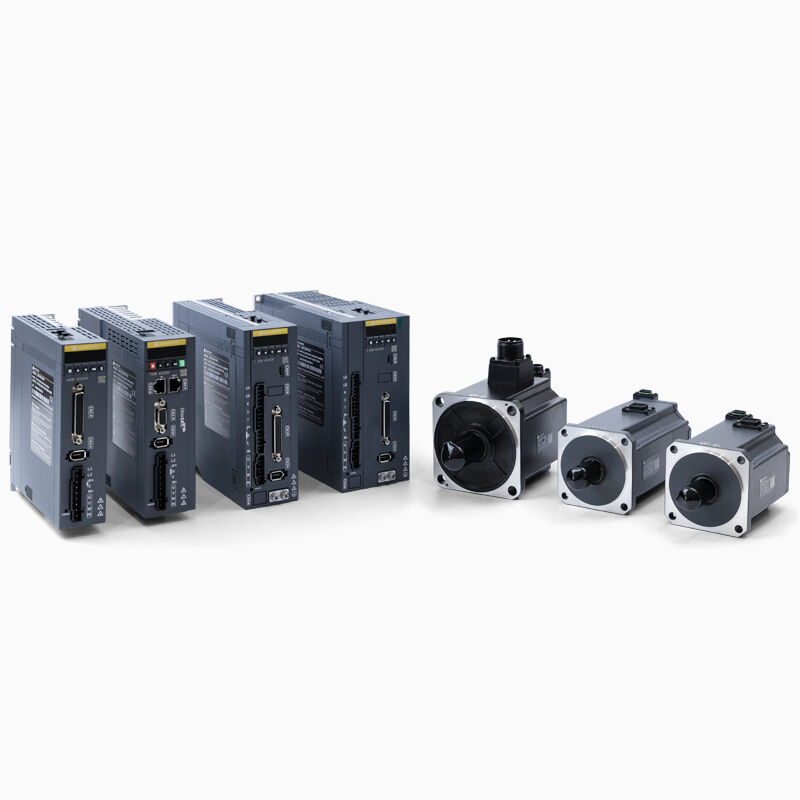
Motor responsiveness in motion control systems directly influences precision, efficiency, and overall performance across industrial applications. When examining servo motor technologies, understanding why responsiveness matters becomes crucial for engineers selecting between different motor types, including both DC servo motors and ac servo motor alternatives. The ability of a motor to quickly respond to control signals determines the system's capability to maintain accurate positioning, handle dynamic load changes, and achieve desired motion profiles under varying operational conditions.
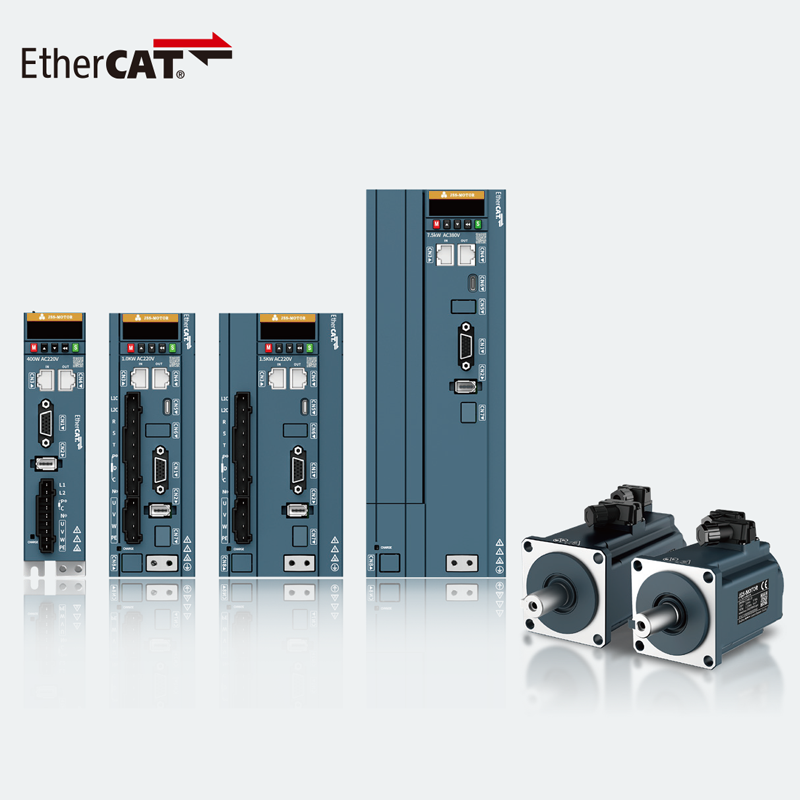
The significance of servo motor responsiveness extends beyond basic speed control to encompass critical factors such as settling time, overshoot minimization, and disturbance rejection capabilities. Modern motion systems require motors that can execute complex trajectories while maintaining stability and accuracy, whether dealing with high-speed pick-and-place operations or precise manufacturing processes. This responsiveness characteristic becomes particularly important when comparing DC servo motors with ac servo motor systems, as each technology offers distinct advantages in different operational scenarios.
Fundamental Principles of Servo Motor Responsiveness
Control Loop Dynamics and Response Characteristics
Servo motor responsiveness fundamentally depends on the control loop dynamics that govern how quickly and accurately the motor responds to command signals. The closed-loop control system continuously monitors the motor's position, velocity, and sometimes torque, comparing these values against the commanded setpoints. When examining DC servo motors versus ac servo motor systems, the control loop behavior differs significantly due to inherent design characteristics and commutation methods.
The responsiveness of a servo motor is mathematically described by its transfer function, which defines the relationship between input commands and output motion. Key parameters include bandwidth, which determines the frequency range over which the motor can effectively respond, and phase margin, which affects stability and overshoot characteristics. DC servo motors typically exhibit simpler control dynamics due to their linear torque-speed relationship, while ac servo motor systems require more sophisticated control algorithms to manage the complex electromagnetic interactions.
Settling time represents another crucial aspect of responsiveness, measuring how quickly the motor reaches and maintains its target position within acceptable tolerances. This parameter directly impacts system throughput and precision in applications such as CNC machining, robotics, and automated assembly. The motor's ability to minimize settling time while avoiding excessive overshoot determines the overall system performance and reliability.
Electrical and Mechanical Time Constants
The electrical time constant of a servo motor describes how quickly the current can change in response to voltage changes, directly affecting the motor's ability to generate rapid torque variations. DC servo motors generally have shorter electrical time constants compared to ac servo motor designs, particularly in brush-type configurations where the commutation is purely electrical. However, modern brushless DC motors and ac servo motor systems have achieved comparable electrical response times through advanced control techniques.
Mechanical time constants relate to the motor's rotor inertia and the system's mechanical compliance, determining how quickly the motor can accelerate or decelerate. Lower rotor inertia typically translates to better responsiveness, as the motor can change speed more rapidly. This characteristic explains why many high-performance applications prefer motors with optimized rotor designs that minimize inertia while maintaining sufficient torque output capabilities.
The interaction between electrical and mechanical time constants creates the overall system responsiveness profile. When the electrical time constant is much smaller than the mechanical time constant, the current control loop can respond much faster than the mechanical system, allowing for excellent torque control. Understanding these relationships helps engineers select appropriate motor types and optimize control parameters for specific applications.
Impact on System Performance and Precision
Positioning Accuracy and Repeatability
Motor responsiveness directly affects positioning accuracy by determining how well the system can track commanded motion profiles and reject disturbances. High responsiveness enables the motor to quickly correct positioning errors, maintaining tight tolerances even under varying load conditions. This capability is essential in precision manufacturing applications where dimensional accuracy directly impacts product quality and compliance with specifications.
Repeatability, the ability to return to the same position consistently over multiple cycles, depends heavily on the motor's responsive characteristics. A highly responsive servo motor can compensate for mechanical variations, thermal effects, and external disturbances more effectively than a sluggish system. When comparing DC servo motors with ac servo motor systems, both can achieve excellent repeatability when properly designed and controlled, but the specific application requirements often favor one technology over the other.
The relationship between responsiveness and accuracy becomes particularly evident in multi-axis systems where coordinated motion is required. Each axis must respond consistently to maintain proper trajectory following, preventing accumulation of positioning errors that could compromise the overall system performance. Advanced servo systems incorporate feedforward control and adaptive algorithms to enhance responsiveness and maintain accuracy across varying operational conditions.
Dynamic Load Handling and Disturbance Rejection
Responsive servo motors excel at handling dynamic load changes without significant position or velocity errors. When external forces act on the system, a responsive motor can quickly adjust its torque output to maintain the desired motion profile. This capability is crucial in applications such as material handling, where load variations are common and unpredictable.
Disturbance rejection performance depends on the motor's ability to detect and compensate for external influences rapidly. The control system's bandwidth and the motor's torque response characteristics determine how effectively disturbances can be rejected. Higher bandwidth systems can respond to higher frequency disturbances, providing better overall performance in challenging environments.
The servo motor's responsiveness also affects its ability to maintain smooth motion during load transitions. Poor responsiveness can result in jerky motion, vibrations, or oscillations that compromise system performance and potentially damage mechanical components. Both DC servo motors and ac servo motor systems can provide excellent disturbance rejection when properly designed, but the specific control strategies and hardware implementations differ significantly between these technologies.
Application-Specific Responsiveness Requirements
High-Speed Manufacturing and Assembly
High-speed manufacturing applications demand exceptional motor responsiveness to achieve target cycle times while maintaining precision. Pick-and-place operations, for example, require rapid acceleration and deceleration with precise positioning at each location. The motor must respond quickly to command changes while minimizing settling time and avoiding overshoot that could cause product damage or misalignment.
Electronic component assembly represents a particularly demanding application where responsiveness directly impacts throughput and quality. The servo motors must execute complex motion profiles with sub-millisecond timing precision while handling varying component weights and sizes. AC servo motor systems often excel in these applications due to their ability to provide consistent torque characteristics and precise speed control across wide operating ranges.
Packaging machinery requires servo motors that can respond rapidly to product flow variations and maintain synchronization with other machine components. The responsiveness requirements often include the ability to handle emergency stops, product jams, and format changes without compromising system integrity. Modern ac servo motor designs incorporate advanced control features that enable rapid response to changing operational conditions while maintaining smooth, precise motion.
Precision Machining and Tool Control
CNC machining applications require servo motors with exceptional responsiveness to maintain cutting tool position accuracy under varying cutting forces. The motor must respond rapidly to programmed path corrections while rejecting disturbances caused by material removal forces. Poor responsiveness can result in dimensional inaccuracies, surface finish defects, and potential tool damage.
Tool changing systems in machining centers rely on responsive servo motors to execute rapid, precise movements that minimize downtime. The motors must accelerate quickly to transport tools between storage positions and the spindle, then decelerate smoothly to ensure precise alignment without impact forces that could damage the tool or spindle interface.
Adaptive machining systems that adjust cutting parameters based on real-time feedback require servo motors with excellent responsiveness to implement control changes rapidly. Whether using DC servo motors or ac servo motor systems, the ability to modify cutting speeds, feed rates, and tool positions in real-time depends heavily on the motor's responsive characteristics and the control system's bandwidth.
Responsiveness Optimization Strategies
Control Algorithm Enhancement
Modern servo systems employ sophisticated control algorithms to maximize motor responsiveness while maintaining stability. PID control forms the foundation, but advanced techniques such as feedforward control, state feedback, and adaptive control significantly improve response characteristics. These algorithms predict system behavior and precompensate for known disturbances, reducing the reactive burden on the feedback control system.
Velocity and acceleration feedforward control helps the servo system anticipate required motor torques based on the commanded motion profile. This predictive approach reduces position following errors and improves overall responsiveness by providing the motor with appropriate drive signals before errors develop. The effectiveness of feedforward control depends on accurate system modeling and proper tuning of feedforward gains.
Advanced ac servo motor controllers incorporate field-oriented control (FOC) techniques that optimize the electromagnetic interactions within the motor. These methods enable independent control of flux and torque-producing currents, maximizing the motor's dynamic response capabilities. Similar optimization techniques are applied to DC servo motors through advanced commutation strategies and current control methods.
Hardware Design and Selection Considerations
Motor selection significantly impacts system responsiveness, with factors such as rotor inertia, torque constants, and electrical time constants playing crucial roles. Low-inertia motors can accelerate and decelerate more rapidly, improving overall system responsiveness. However, the motor must also provide sufficient torque to handle the application's load requirements without compromising performance.
Drive amplifier characteristics directly affect motor responsiveness through current control bandwidth and switching frequencies. Higher switching frequencies enable faster current control loops, improving the motor's ability to respond to torque commands. Modern ac servo motor drives incorporate advanced power electronics and control processors that maximize responsiveness while maintaining efficiency and reliability.
System mechanical design influences responsiveness through factors such as mechanical compliance, backlash, and damping characteristics. Rigid mechanical connections minimize compliance effects that can introduce delays and oscillations in the control system. Proper mechanical design ensures that the motor's inherent responsiveness is translated effectively to the load, maximizing overall system performance.
FAQ
How does servo motor responsiveness affect overall system efficiency?
Higher servo motor responsiveness typically improves system efficiency by enabling faster cycle times, reducing settling delays, and minimizing energy consumption during motion transitions. Responsive motors can execute motion profiles more accurately, reducing the need for corrective movements that waste energy. Additionally, better responsiveness allows for more aggressive motion profiles that can increase throughput while maintaining precision, ultimately improving the overall productivity and energy efficiency of the motion system.
What are the key differences in responsiveness between DC servo motors and AC servo motors?
DC servo motors traditionally offered simpler control and potentially faster electrical response due to their linear characteristics, while ac servo motor systems provide superior performance through advanced control algorithms and design flexibility. Modern ac servo motor systems often achieve comparable or superior responsiveness through field-oriented control and high-frequency switching, while also offering advantages in efficiency, reliability, and speed range. The choice depends on specific application requirements, with both technologies capable of excellent responsiveness when properly designed and implemented.
How can engineers measure and evaluate servo motor responsiveness in their applications?
Engineers can evaluate servo motor responsiveness through several key metrics including step response time, bandwidth measurement, settling time analysis, and disturbance rejection testing. Practical evaluation involves measuring the motor's ability to track commanded motion profiles, analyzing position following errors during acceleration and deceleration, and assessing the system's response to external disturbances. Frequency response analysis provides insight into the system's bandwidth and stability margins, while time-domain testing reveals settling characteristics and overshoot behavior under actual operating conditions.
What role does encoder resolution play in achieving optimal servo motor responsiveness?
Encoder resolution directly impacts the servo system's ability to detect and respond to small position changes, with higher resolution enabling more precise control and potentially better responsiveness. However, the relationship is not linear, as excessively high resolution can introduce noise and computational delays that may actually reduce effective responsiveness. The optimal encoder resolution depends on the application's precision requirements, the control system's processing capabilities, and the mechanical resolution of the system. Proper encoder selection balances resolution, update rate, and noise characteristics to maximize overall system responsiveness and performance.
Table of Contents
- Fundamental Principles of Servo Motor Responsiveness
- Impact on System Performance and Precision
- Application-Specific Responsiveness Requirements
- Responsiveness Optimization Strategies
-
FAQ
- How does servo motor responsiveness affect overall system efficiency?
- What are the key differences in responsiveness between DC servo motors and AC servo motors?
- How can engineers measure and evaluate servo motor responsiveness in their applications?
- What role does encoder resolution play in achieving optimal servo motor responsiveness?