
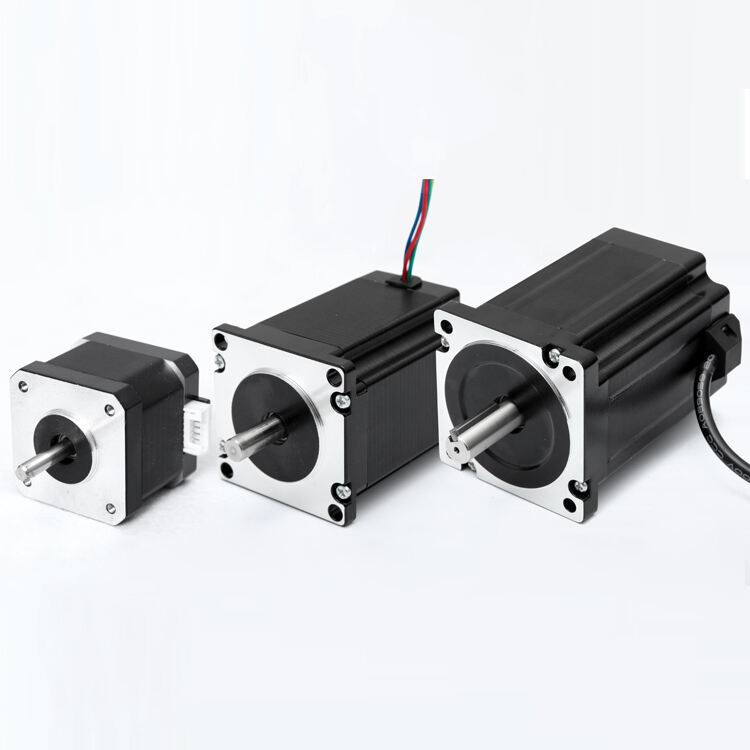
In the rapidly evolving world of industrial automation and precision machinery, the step motor has emerged as a cornerstone technology for applications requiring exact positioning control. These electromagnetic devices convert digital pulses into precise mechanical rotation, making them indispensable in countless positioning-based systems across manufacturing, robotics, and scientific instrumentation. The inherent precision of a step motor lies in its ability to move in discrete, predictable increments, typically ranging from 0.9 to 15 degrees per step, depending on the specific design configuration.
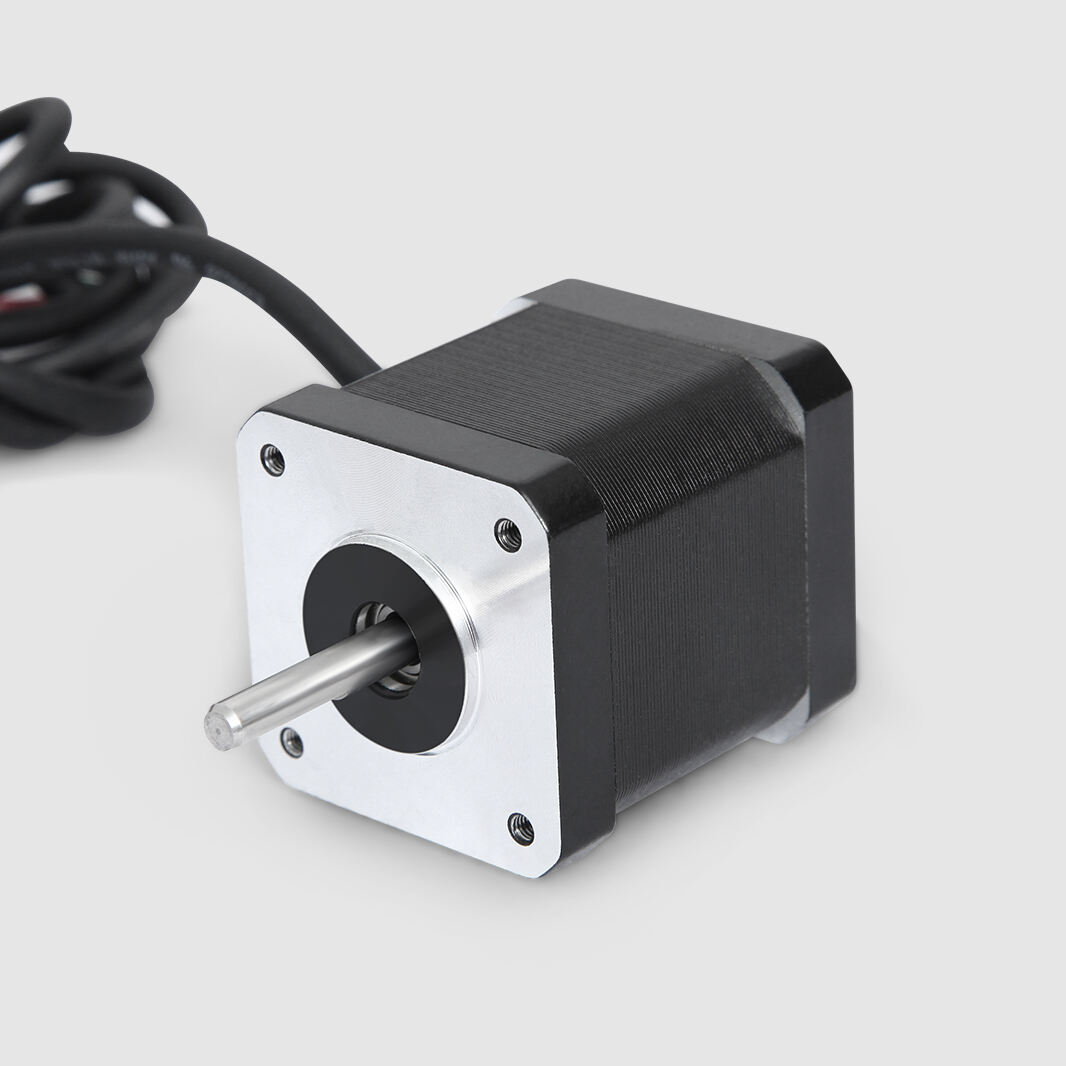
Modern positioning systems demand unprecedented accuracy, and the step motor delivers this through its open-loop control characteristics that eliminate the need for complex feedback systems in many applications. Unlike servo motors that require encoders and sophisticated control algorithms, a step motor can achieve remarkable positioning accuracy through simple pulse counting and timing control. This fundamental advantage translates into reduced system complexity, lower implementation costs, and enhanced reliability in mission-critical positioning applications.
The precision capabilities of step motor technology have revolutionized industries ranging from 3D printing and CNC machining to medical device manufacturing and semiconductor production. Engineers increasingly rely on these motors because they provide deterministic motion control, meaning that each input pulse produces a known angular displacement regardless of load variations within the motor's operating range. This predictable behavior forms the foundation of accurate positioning systems that maintain tight tolerances over extended operating periods.
Fundamental Precision Characteristics of Step Motor Technology
Angular Resolution and Step Accuracy
The precision of a step motor fundamentally stems from its construction methodology, which divides a complete 360-degree rotation into numerous discrete steps. Standard step motor designs typically offer 200 steps per revolution, resulting in 1.8-degree step angles that provide exceptional angular resolution for positioning applications. Higher resolution variants can achieve 400 or even 800 steps per revolution through advanced magnetic pole configurations and sophisticated winding arrangements. This inherent step accuracy ensures that positioning systems can achieve repeatable precision within ±3% of the full step angle under optimal operating conditions.
Microstepping technology further enhances the precision capabilities of step motor systems by subdividing each full step into smaller increments through precise current control in the motor windings. Advanced microstepping drivers can divide each full step into 256 or more microsteps, effectively increasing the resolution to 51,200 positions per revolution. This remarkable precision enables step motor applications to achieve positioning accuracies measured in micrometers, making them suitable for the most demanding precision positioning requirements in modern manufacturing and research environments.
Positioning Repeatability and Consistency
One of the most valued characteristics of step motor technology is its exceptional positioning repeatability, which refers to the motor's ability to return to the same angular position with minimal variation across multiple positioning cycles. High-quality step motor systems can achieve repeatability specifications within ±0.05% of a full step, translating to arc-minute level accuracy in many applications. This consistency results from the motor's magnetic detent torque, which naturally positions the rotor at stable equilibrium points between magnetic poles, providing inherent position retention without continuous power consumption.
The deterministic nature of step motor positioning eliminates cumulative positioning errors that can plague other motion control technologies over extended operation periods. Each step pulse produces a known angular displacement that remains consistent regardless of previous positioning history, ensuring that long sequences of positioning moves maintain their accuracy without requiring periodic recalibration. This characteristic makes step motor technology particularly valuable in applications such as automated manufacturing lines, where consistent positioning accuracy directly impacts product quality and production efficiency.
Applications Demanding High Precision Step Motor Control
Industrial Automation and Manufacturing Systems
Manufacturing automation systems increasingly rely on step motor technology to achieve the precision positioning required for modern production processes. Automated assembly lines utilize these motors for precise component placement, where positioning accuracies within tens of micrometers determine product quality and assembly success rates. Pick-and-place machines in electronics manufacturing depend on step motor precision to accurately position components on circuit boards, where misalignment by even fraction of a millimeter can result in defective products and costly rework processes.
CNC machining centers incorporate step motor technology in their axis drive systems to achieve the precise tool positioning required for complex part geometries and tight dimensional tolerances. The open-loop control characteristics of step motor systems provide the deterministic motion control necessary for maintaining consistent cutting parameters and surface finish quality across production runs. Advanced CNC systems often employ multiple step motor units working in coordination to control multi-axis positioning with synchronized precision, enabling the production of intricate components that meet demanding aerospace and automotive quality standards.
Medical Device and Laboratory Equipment
Medical equipment manufacturers extensively utilize step motor technology in applications where positioning precision directly impacts patient safety and diagnostic accuracy. Automated laboratory analyzers depend on step motor systems to precisely position sample containers and analytical probes, where positioning errors can compromise test results and lead to misdiagnosis. Surgical robots incorporate multiple step motor units to control instrument positioning with sub-millimeter accuracy, enabling minimally invasive procedures that reduce patient trauma and recovery times while improving surgical outcomes.
Imaging systems in medical and research applications rely on step motor precision for accurate sample positioning and scanning control. Microscopy systems use step motor technology to control focus mechanisms and stage positioning, enabling researchers to capture high-resolution images with precise spatial registration. The inherent precision and reliability of step motor systems make them ideal for these critical applications where positioning accuracy cannot be compromised, and system failures could have serious consequences for patient care or research integrity.
Technical Advantages in Positioning System Design
Open-Loop Control Simplicity
The open-loop control capability of step motor systems provides significant advantages in positioning system design by eliminating the complexity and cost associated with feedback sensors and closed-loop control algorithms. Unlike servo motor systems that require encoders, resolvers, or other position feedback devices, a step motor can achieve precise positioning through simple pulse counting and timing control. This simplification reduces system component count, minimizes potential failure points, and significantly lowers implementation costs while maintaining excellent positioning accuracy for most industrial applications.
Open-loop step motor control also provides inherent immunity to electrical noise and interference that can disrupt encoder signals in servo systems. This robustness makes step motor technology particularly valuable in harsh industrial environments where electromagnetic interference from welding equipment, motor drives, and power switching devices can compromise positioning accuracy in feedback-dependent systems. The digital nature of step motor control pulses provides excellent noise immunity, ensuring consistent positioning performance even in electrically challenging environments.
Load Independence and Torque Characteristics
Step motor technology exhibits excellent load independence characteristics within its specified torque range, maintaining positioning accuracy regardless of load variations that might affect other motor technologies. The holding torque capability of a step motor provides secure position retention without continuous power consumption, making it ideal for applications where loads must be maintained in position for extended periods. This characteristic eliminates concerns about position drift under varying load conditions and ensures that positioning accuracy remains consistent throughout the operating cycle.
The torque-speed characteristics of step motor systems provide predictable performance across a wide range of operating conditions, enabling engineers to accurately model system behavior and optimize positioning performance. Modern step motor designs incorporate advanced magnetic materials and optimized winding configurations that deliver high torque density while maintaining smooth operation and minimal vibration. These improvements have expanded the application range of step motor technology into higher-speed positioning systems while preserving the precision advantages that make these motors valuable for demanding positioning applications.
Performance Optimization Strategies
Driver Technology and Control Methods
Advanced driver technology plays a crucial role in maximizing the precision capabilities of step motor systems through sophisticated current control algorithms and microstepping techniques. Modern step motor drivers incorporate digital signal processors that execute complex current waveforms designed to minimize resonance, reduce vibration, and optimize torque smoothness across the entire speed range. These intelligent drivers automatically adjust operating parameters based on load conditions and speed requirements, ensuring optimal positioning performance while protecting the motor from damage due to overcurrent or overheating conditions.
Closed-loop step motor control represents an emerging technology that combines the simplicity of step motor operation with the precision assurance of encoder feedback. These hybrid systems maintain the open-loop operational characteristics of traditional step motor control while incorporating position verification to detect and correct any step loss or positioning errors that might occur due to excessive loads or mechanical disturbances. This approach provides the best of both worlds: simple control implementation with enhanced precision assurance for critical positioning applications.
Mechanical Integration and System Design
Proper mechanical integration significantly impacts the positioning precision achievable with step motor systems, requiring careful attention to coupling selection, bearing preload, and structural rigidity. Flexible couplings help isolate the step motor from mechanical misalignments and shock loads while transmitting torque efficiently, but coupling compliance can introduce positioning errors if not properly accounted for in system design. Rigid coupling systems provide better positioning accuracy but require precise mechanical alignment and may transmit harmful loads to motor bearings if misalignment occurs.
Gear reduction systems often accompany step motor installations to increase output torque while simultaneously improving positioning resolution through mechanical advantage. However, gear backlash can introduce positioning errors in bidirectional applications, requiring careful gear selection and preload mechanisms to maintain positioning accuracy. Anti-backlash gear designs and preloaded gear trains help minimize these effects, enabling step motor systems to achieve exceptional positioning precision even when mechanical reduction is required for torque multiplication or speed reduction purposes.
Industry-Specific Precision Requirements
Semiconductor and Electronics Manufacturing
The semiconductor industry represents one of the most demanding applications for step motor precision, where positioning accuracies measured in nanometers determine production yield and device performance. Wafer processing equipment utilizes step motor technology for precise substrate positioning during photolithography, etching, and deposition processes, where even microscopic positioning errors can result in defective integrated circuits and significant financial losses. Advanced step motor systems in these applications often incorporate environmental compensation and thermal stability measures to maintain positioning accuracy despite temperature variations and mechanical thermal expansion effects.
Electronics assembly operations depend on step motor precision for component placement on increasingly dense circuit boards, where component miniaturization continually pushes positioning accuracy requirements to new levels. Modern surface-mount technology demands positioning tolerances that often exceed the capabilities of basic step motor systems, driving the development of enhanced microstepping techniques and precision feedback integration. These applications demonstrate how step motor technology continues to evolve to meet the ever-increasing precision demands of advanced manufacturing processes.
Aerospace and Defense Applications
Aerospace applications utilize step motor technology in critical positioning systems where reliability and precision must be maintained under extreme environmental conditions including temperature variations, vibration, and radiation exposure. Satellite pointing systems incorporate step motor assemblies for precise antenna positioning and solar panel orientation, where positioning errors directly impact communication quality and power generation efficiency. The vacuum compatibility and radiation hardness of specialized step motor designs make them suitable for space applications where conventional motors might fail due to outgassing or radiation damage.
Defense systems rely on step motor precision for weapon targeting, surveillance equipment positioning, and navigation system components, where positioning accuracy can determine mission success and personnel safety. These applications often require step motor systems that maintain their precision specifications despite exposure to shock loads, extreme temperatures, and electromagnetic interference from radar and communication systems. Military-grade step motor assemblies incorporate enhanced environmental sealing and ruggedized construction while preserving the positioning accuracy required for effective system operation.
Future Developments in Step Motor Precision
Advanced Materials and Manufacturing
Emerging materials science developments continue to enhance step motor precision through improved magnetic materials, bearing technologies, and manufacturing processes. Advanced permanent magnet materials with higher energy densities enable the design of more compact step motor assemblies while maintaining or improving torque output and positioning accuracy. Precision manufacturing techniques including laser cutting, wire electrical discharge machining, and advanced surface treatments contribute to tighter component tolerances and improved motor performance consistency across production runs.
Additive manufacturing technologies are beginning to impact step motor component production, enabling the creation of complex magnetic circuit geometries that were previously impossible with conventional manufacturing methods. These advanced manufacturing approaches may lead to step motor designs with improved magnetic flux distribution and reduced cogging torque, further enhancing positioning precision and smoothness. Research into novel magnetic materials and manufacturing techniques continues to push the boundaries of what is achievable with step motor technology in precision positioning applications.
Integration with Smart Control Systems
The integration of artificial intelligence and machine learning algorithms into step motor control systems represents an emerging trend that promises to enhance positioning precision through adaptive optimization and predictive maintenance capabilities. Smart step motor controllers can analyze operating patterns, environmental conditions, and performance metrics to automatically optimize control parameters for maximum precision under varying operational conditions. These intelligent systems can detect degradation in positioning accuracy and implement compensating adjustments or alert operators to maintenance requirements before precision is compromised.
Internet of Things connectivity enables step motor systems to participate in networked manufacturing environments where positioning data can be analyzed across multiple machines to identify trends and optimization opportunities. Distributed control systems can coordinate multiple step motor units to achieve synchronized positioning with unprecedented precision, opening new possibilities for complex manufacturing processes and collaborative robotic systems. These developments suggest that step motor technology will continue to play a crucial role in the future of precision positioning applications as manufacturing systems become increasingly sophisticated and interconnected.
FAQ
What makes step motor technology superior for precision positioning compared to other motor types
Step motor technology offers inherent positioning advantages through its discrete step operation, which provides predictable angular displacement for each input pulse without requiring position feedback sensors. This open-loop control capability simplifies system design while delivering excellent positioning repeatability and accuracy for most industrial applications. The motor's holding torque maintains position without continuous power consumption, and the digital control interface provides excellent noise immunity in harsh industrial environments.
How does microstepping improve step motor positioning precision
Microstepping enhances step motor precision by subdividing each full step into smaller increments through precise current control in the motor windings. Advanced microstepping drivers can create 256 or more microsteps per full step, effectively increasing resolution to over 50,000 positions per revolution. This technique reduces vibration, improves torque smoothness, and enables positioning accuracies measured in micrometers for demanding precision applications while maintaining the simplicity of step motor control.
What factors can affect step motor positioning accuracy in real-world applications
Several factors can influence step motor positioning accuracy including mechanical resonance, load variations, temperature effects, and driver current regulation. Mechanical coupling backlash, bearing wear, and structural compliance can introduce positioning errors, while inadequate driver current can result in step loss under high load conditions. Proper system design addressing these factors through appropriate component selection, mechanical integration, and control parameter optimization ensures optimal positioning performance throughout the motor's operational life.
When should closed-loop control be considered for step motor applications
Closed-loop control becomes valuable for step motor applications when positioning accuracy requirements exceed what can be reliably achieved through open-loop operation, or when step loss detection is critical for safety or quality reasons. Applications involving variable loads, potential mechanical obstructions, or extreme precision requirements may benefit from encoder feedback to verify positioning accuracy and detect any step loss conditions. However, most positioning applications can achieve excellent results with properly designed open-loop step motor systems at significantly lower cost and complexity.
Table of Contents
- Fundamental Precision Characteristics of Step Motor Technology
- Applications Demanding High Precision Step Motor Control
- Technical Advantages in Positioning System Design
- Performance Optimization Strategies
- Industry-Specific Precision Requirements
- Future Developments in Step Motor Precision
-
FAQ
- What makes step motor technology superior for precision positioning compared to other motor types
- How does microstepping improve step motor positioning precision
- What factors can affect step motor positioning accuracy in real-world applications
- When should closed-loop control be considered for step motor applications