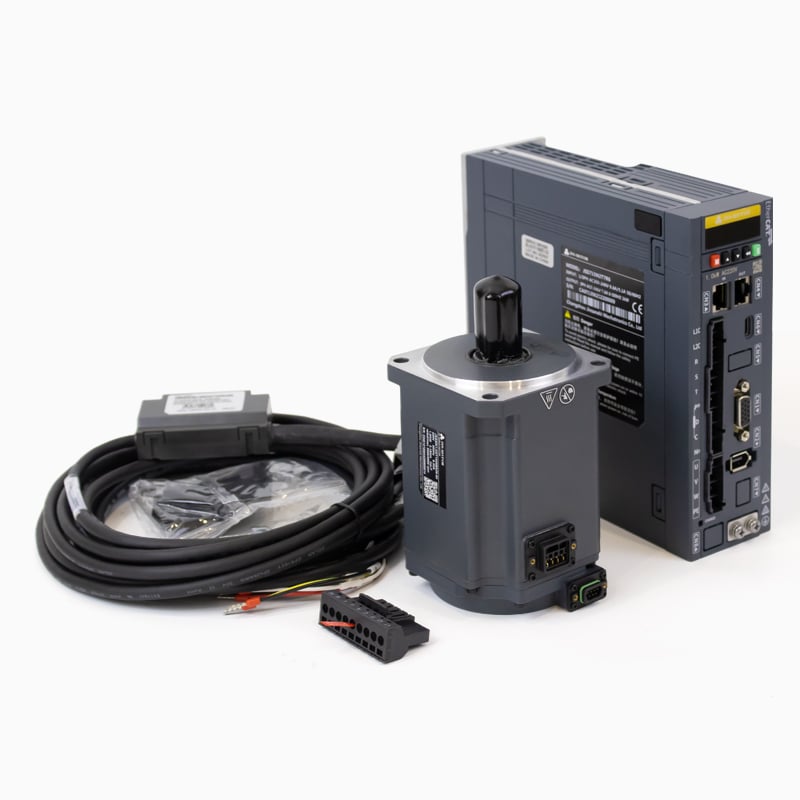
In modern industrial automation, the ability to coordinate multiple axes of motion simultaneously is one of the most demanding challenges engineers face. Whether the application involves a six-axis robotic arm, a CNC machining center, or a high-speed packaging line, the precision and synchronization required across each axis must be flawless. At the heart of this capability are servo motors and drives, which provide the closed-loop control, real-time responsiveness, and communication intelligence needed to make multi-axis coordination not just possible, but reliable and repeatable at production scale.
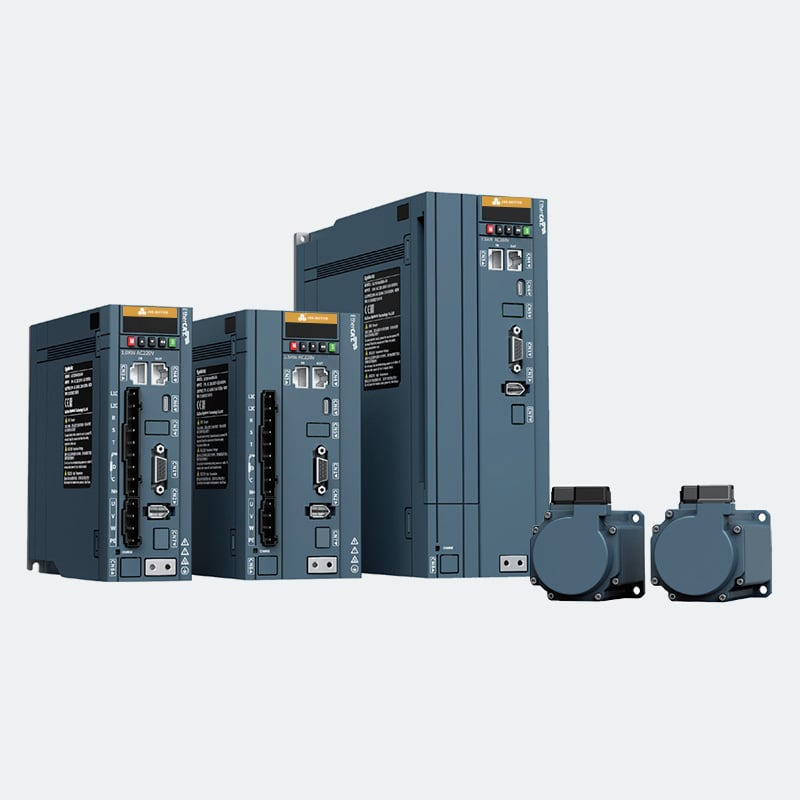
Understanding how servo motors and drives support multi-axis coordination requires looking beyond individual axis performance. It means examining how each drive communicates with a central controller, how position and velocity feedback is synchronized across axes, and how the system architecture enables tight interpolation between movements. This article breaks down the mechanisms, communication protocols, and engineering principles that allow servo motors and drives to function as a unified, coordinated motion system rather than a collection of independent actuators.
The Role of Closed-Loop Control in Multi-Axis Systems
Why Feedback Is the Foundation of Coordination
Multi-axis coordination depends entirely on each axis knowing exactly where it is at every moment. Servo motors and drives achieve this through closed-loop control, where a high-resolution encoder continuously reports the motor's actual position back to the drive. The drive compares this feedback against the commanded position and makes real-time corrections to eliminate any error. Without this feedback loop, even small deviations on one axis would compound across the system, causing the coordinated path to drift and the final output to be inaccurate.
In a multi-axis environment, each servo drive operates its own closed-loop independently while simultaneously receiving synchronized commands from a master controller. This dual responsibility — local correction and global synchronization — is what makes servo motors and drives uniquely suited for coordinated motion. A stepper motor, by contrast, operates open-loop and cannot confirm its actual position, making it unsuitable for applications where axes must track each other with sub-millimeter precision.
The encoder resolution plays a critical role here. Higher-resolution encoders, such as 23-bit optical encoders, provide over eight million counts per revolution, giving the drive an extremely fine-grained picture of the motor's position. This granularity allows the drive to detect and correct even the smallest positional errors before they propagate into the coordinated motion path, which is essential when multiple axes must trace a complex trajectory together.
Velocity and Torque Loops Supporting Position Accuracy
Servo motors and drives typically operate with three nested control loops: an outer position loop, a middle velocity loop, and an inner torque loop. Each loop runs at a different update rate, with the torque loop executing fastest — often at tens of kilohertz — to ensure the motor responds instantly to load changes. This cascaded structure means that when one axis encounters a sudden load disturbance, the drive compensates within microseconds, preventing the disturbance from disrupting the coordinated path.
In multi-axis applications, this fast torque response is especially important during acceleration and deceleration phases, where inertia mismatches between axes can cause one axis to lag behind another. Well-tuned servo motors and drives manage these transitions smoothly by adjusting torque output dynamically, keeping all axes on their commanded trajectories even during the most demanding motion profiles.
Communication Protocols That Enable Real-Time Synchronization
EtherCAT and Deterministic Network Timing
The synchronization of multiple servo motors and drives across a machine depends heavily on the communication protocol connecting them to the motion controller. EtherCAT has become one of the most widely adopted protocols for this purpose because it offers deterministic, cycle-time-consistent communication with update rates as fast as 250 microseconds. In a multi-axis system, every drive receives its position command at exactly the same moment within each communication cycle, ensuring that all axes begin their motion updates simultaneously.
This determinism is what separates industrial fieldbus protocols from standard Ethernet. In a conventional network, packet delivery times vary unpredictably, which would cause different axes to receive their commands at slightly different times. Even a few microseconds of jitter between axes can translate into visible path errors in high-speed applications. EtherCAT eliminates this problem by using a ring topology where each drive reads and writes its data as the frame passes through, with the entire cycle completing in a fixed, repeatable time window.
Servo motors and drives designed for EtherCAT integration include hardware synchronization features such as distributed clocks, which align the internal timers of every drive on the network to within nanoseconds of each other. This clock alignment ensures that even if the communication cycle introduces any latency, all drives execute their motion updates at the same physical instant, maintaining tight inter-axis synchronization throughout the entire motion sequence.
Other Fieldbus Options and Their Trade-offs
While EtherCAT is a leading choice for high-performance multi-axis systems, servo motors and drives are also available with support for other industrial protocols including PROFINET, CANopen, and MECHATROLINK. Each protocol offers different trade-offs in terms of cycle time, network topology, and controller compatibility. CANopen, for example, is well-established in simpler multi-axis applications where update rates of a few milliseconds are acceptable, while PROFINET IRT offers deterministic performance suitable for moderate-speed coordination tasks.
The choice of protocol affects not only synchronization quality but also the complexity of the system architecture. Engineers selecting servo motors and drives for a new multi-axis machine must consider the controller's native protocol support, the number of axes to be coordinated, the required update rate, and the cable infrastructure available in the facility. Getting this selection right at the design stage avoids costly retrofits later and ensures the system can scale if additional axes are added in the future.
Interpolation Modes and Coordinated Path Execution
Linear and Circular Interpolation Across Axes
Multi-axis coordination is not simply about moving each axis independently to a target position. In most real applications, the axes must move together along a defined path — a straight line, an arc, or a complex spline curve — where the ratio of movement between axes changes continuously throughout the motion. This is called interpolation, and it is one of the primary functions that servo motors and drives must support to enable true multi-axis coordination.
In linear interpolation, the motion controller calculates the required velocity ratio between axes so that all axes arrive at the target position simultaneously, tracing a straight line in the combined motion space. For a two-axis system moving a tool diagonally, this means the X and Y axes must accelerate, travel, and decelerate in a precisely coordinated ratio. Servo motors and drives execute this by receiving position commands that already encode the interpolated trajectory, updating their position targets every communication cycle to follow the path accurately.
Circular interpolation extends this concept to arcs and circles, requiring the controller to continuously recalculate the velocity components for each axis as the direction of travel changes. The faster the motion and the tighter the arc, the more demanding the interpolation becomes. High-performance servo motors and drives with fast communication cycles and low latency are essential for maintaining path accuracy in these conditions, particularly in applications like laser cutting or precision grinding where contour accuracy directly affects product quality.
Electronic Gearing and Cam Profiles
Beyond interpolated path following, servo motors and drives support multi-axis coordination through electronic gearing and electronic cam functions. Electronic gearing allows one axis to follow another at a defined ratio, effectively replacing a mechanical gearbox with a software-defined relationship. This is widely used in printing, converting, and winding applications where a follower axis must track a master axis at a precise speed ratio that can be changed on the fly without stopping the machine.
Electronic cam profiles take this further by defining a non-linear relationship between a master axis position and a follower axis position, stored as a lookup table or mathematical function within the drive or controller. As the master axis moves, the follower axis executes a complex motion profile that would be impossible to achieve with a physical cam. Servo motors and drives with sufficient processing power and memory can execute these cam profiles at full speed while simultaneously maintaining their own closed-loop position control, enabling highly flexible machine designs that can be reconfigured through software alone.
System Architecture Considerations for Multi-Axis Machines
Centralized vs. Distributed Control Architectures
The way servo motors and drives are organized within a machine's control architecture has a significant impact on how well multi-axis coordination can be achieved. In a centralized architecture, a single motion controller handles all interpolation calculations and sends position commands to each drive over a fieldbus network. This approach gives the controller complete visibility over all axes and makes it straightforward to implement complex coordinated motion profiles, but it places high demands on the controller's processing power and the network's communication speed.
In a distributed architecture, more intelligence is pushed into the individual servo motors and drives themselves. Each drive may handle its own interpolation segment or execute a pre-loaded motion program, with the central controller providing only high-level coordination signals. This reduces the communication bandwidth required and can improve fault tolerance, since a single drive failure does not necessarily halt the entire system. Modern servo motors and drives increasingly support both architectures, giving machine builders the flexibility to choose the approach that best fits their application requirements.
Tuning and Commissioning for Coordinated Performance
Even the most capable servo motors and drives will not deliver good multi-axis coordination if they are not properly tuned. Each axis has its own mechanical characteristics — inertia, friction, compliance, and resonance frequencies — that must be accounted for in the drive's control loop parameters. If one axis is tuned too aggressively and another too conservatively, the axes will respond differently to the same command profile, causing path errors and potential mechanical stress at the joints or couplings between axes.
Modern servo motors and drives include auto-tuning functions that measure the mechanical load and automatically calculate initial control loop parameters. These auto-tuning routines significantly reduce commissioning time on multi-axis machines, but they are typically followed by manual fine-tuning to optimize performance for the specific motion profiles the machine will execute. Engineers should always verify coordinated path accuracy under actual production conditions, not just during static or slow-speed tests, since dynamic effects only become apparent at full operating speed.
Vibration suppression filters built into servo motors and drives are another important tuning tool for multi-axis systems. Mechanical resonances in the machine structure can cause one axis to oscillate, which then disturbs adjacent axes through shared structural members. Notch filters and low-pass filters within the drive can suppress these resonances without significantly reducing the bandwidth of the position control loop, allowing the system to achieve both high stiffness and smooth coordinated motion.
FAQ
What makes servo motors and drives better than stepper motors for multi-axis coordination?
Servo motors and drives use closed-loop feedback to continuously verify and correct position, which is essential when multiple axes must track each other precisely. Stepper motors operate open-loop and cannot confirm their actual position, making them prone to losing steps under load. In multi-axis applications, a single missed step on one axis can cause the entire coordinated path to deviate, which is why servo motors and drives are the standard choice for demanding coordination tasks.
How does EtherCAT improve multi-axis synchronization compared to older protocols?
EtherCAT provides deterministic communication with cycle times as fast as 250 microseconds and distributed clock synchronization accurate to within nanoseconds. This ensures that all servo motors and drives on the network receive their position commands and execute their motion updates at exactly the same instant, eliminating the timing jitter that older protocols introduce. The result is tighter inter-axis synchronization and better path accuracy, particularly at high speeds where even small timing differences translate into visible contour errors.
Can servo motors and drives handle both position control and torque control in a multi-axis system?
Yes. Servo motors and drives typically support multiple control modes — position, velocity, and torque — and can switch between them dynamically based on commands from the motion controller. In multi-axis systems, some axes may operate in position mode while others operate in torque mode, depending on the application. For example, in a tension control application, a winding axis might operate in torque mode while a feed axis operates in position mode, with the servo motors and drives coordinating their outputs to maintain consistent material tension throughout the process.
How many axes can servo motors and drives coordinate simultaneously?
The number of axes that servo motors and drives can coordinate simultaneously depends on the motion controller's processing capacity and the communication network's bandwidth. Modern EtherCAT-based systems routinely coordinate 16, 32, or even more axes in a single synchronized network, with all axes receiving commands within the same communication cycle. The practical limit is usually determined by the complexity of the motion profiles and the controller's interpolation capabilities rather than by the servo motors and drives themselves, which are designed to scale with the system architecture.
Table of Contents
- The Role of Closed-Loop Control in Multi-Axis Systems
- Communication Protocols That Enable Real-Time Synchronization
- Interpolation Modes and Coordinated Path Execution
- System Architecture Considerations for Multi-Axis Machines
-
FAQ
- What makes servo motors and drives better than stepper motors for multi-axis coordination?
- How does EtherCAT improve multi-axis synchronization compared to older protocols?
- Can servo motors and drives handle both position control and torque control in a multi-axis system?
- How many axes can servo motors and drives coordinate simultaneously?