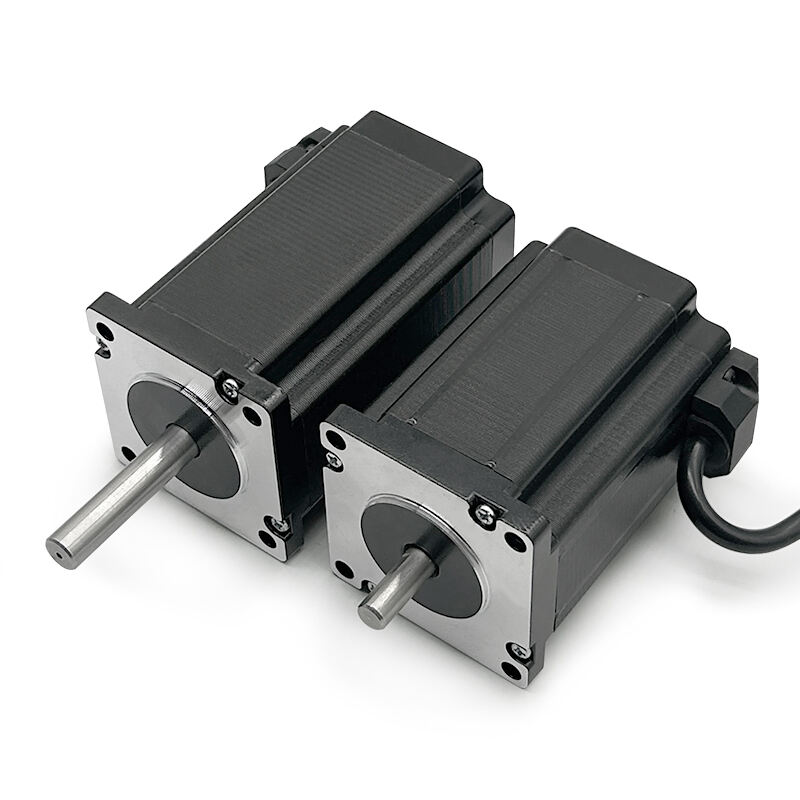
Manufacturing precision and automated control have revolutionized countless industries worldwide, with motion control systems serving as the backbone of modern production processes. Among the most reliable and versatile motion control technologies, the stepper motor stands out as an essential component that drives innovation across diverse industrial sectors. From intricate medical devices to massive manufacturing equipment, these precision motors deliver the accuracy and reliability that today's demanding applications require.
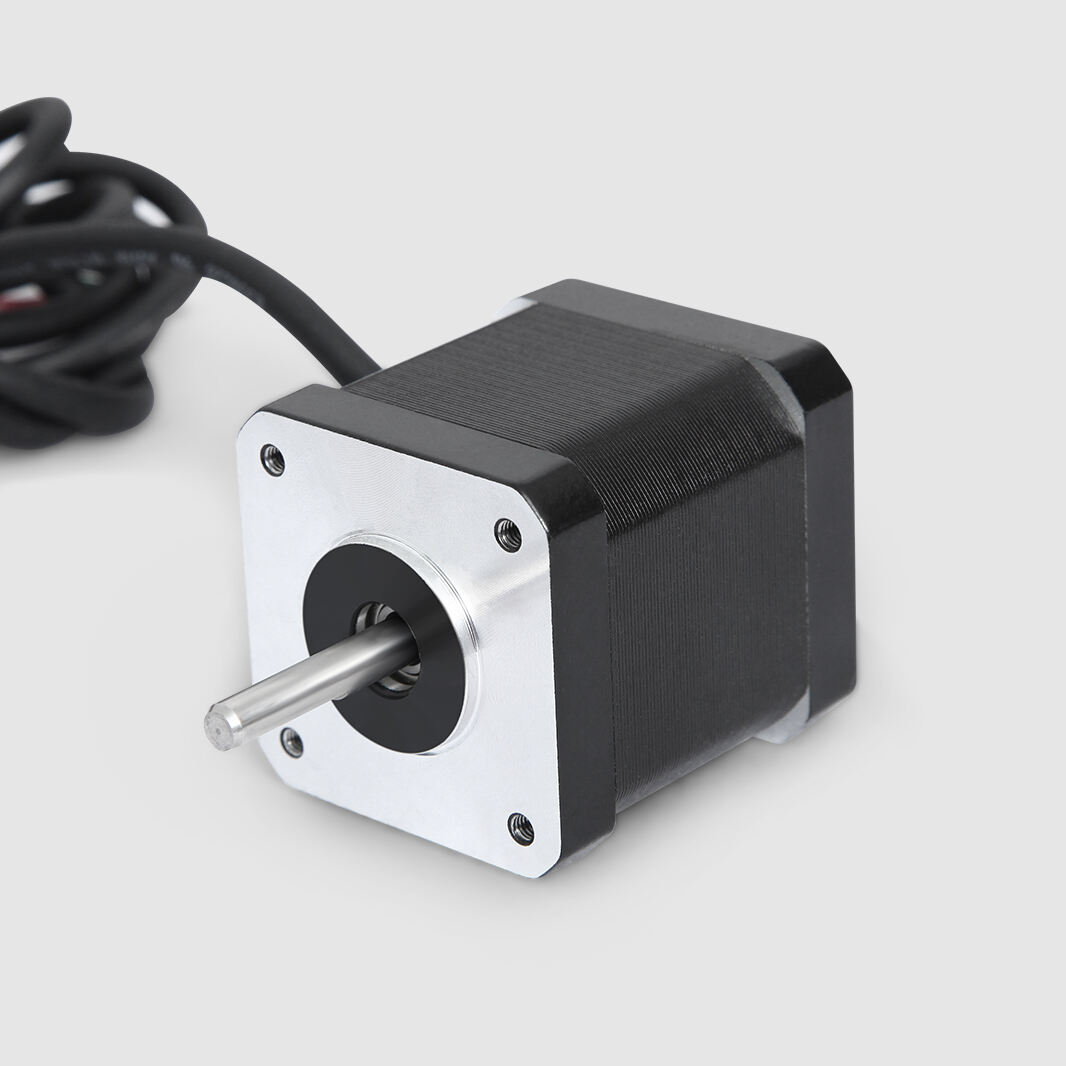
Medical Device Manufacturing and Healthcare Equipment
Precision Surgical Instruments and Robotics
The medical device industry demands exceptional precision and reliability, making stepper motor technology indispensable for surgical robotics and precision instruments. These motors provide the exact positioning control required for robotic surgical systems, where even microscopic movements can determine patient outcomes. Medical equipment manufacturers integrate stepper motors into automated surgical tools, enabling surgeons to perform minimally invasive procedures with unprecedented accuracy.
Stepper motor applications in medical robotics extend to automated suturing systems, precision drug delivery devices, and computer-assisted surgery platforms. The ability to control movement in discrete steps ensures that medical professionals can achieve the exact positioning needed for complex procedures, while the inherent holding torque of these motors provides stability during critical operations.
Laboratory Automation and Diagnostic Equipment
Modern laboratories rely heavily on automated systems for sample processing, analysis, and testing procedures. Stepper motor technology powers liquid handling robots, automated microscopy systems, and sample preparation equipment that must maintain consistent performance across thousands of operations. These motors enable precise pipetting actions, accurate slide positioning, and controlled reagent dispensing in automated laboratory environments.
Diagnostic equipment such as blood analyzers, DNA sequencers, and imaging systems incorporate stepper motors to ensure accurate sample positioning and measurement. The step-by-step control capability allows laboratory equipment to achieve repeatable positioning accuracy that is essential for reliable test results and regulatory compliance in healthcare settings.
3D Printing and Additive Manufacturing
Desktop and Industrial 3D Printing Systems
The 3D printing revolution has been made possible largely through the precision control offered by stepper motor technology. These motors control the movement of print heads, build platforms, and extruder mechanisms in both desktop and industrial additive manufacturing systems. The ability to control positioning in precise increments allows 3D printers to create complex geometries with exceptional layer adhesion and dimensional accuracy.
Industrial additive manufacturing applications require stepper motors that can handle continuous operation while maintaining positioning accuracy over extended print cycles. Advanced 3D printing systems utilize multiple stepper motors working in coordination to control multi-axis movement, enabling the production of intricate parts with tight tolerances that would be impossible to achieve through traditional manufacturing methods.
Material Handling and Extruder Control
Beyond basic positioning, stepper motor technology enables precise control of material flow in 3D printing applications. Extruder systems rely on stepper motors to control filament feeding rates, ensuring consistent material deposition throughout the printing process. This level of control is crucial for maintaining print quality and preventing common issues such as over-extrusion or material starvation.
Multi-material 3D printing systems employ sophisticated stepper motor control schemes to manage complex material switching operations. These systems can alternate between different materials or colors during a single print job, creating parts with varying properties or aesthetic features that would require multiple manufacturing steps using traditional methods.
CNC Machining and Precision Manufacturing
Computer Numerical Control Systems
Computer numerical control machining represents one of the most demanding applications for stepper motor technology in modern manufacturing. CNC machines require precise control of cutting tools across multiple axes, with positioning accuracy measured in thousandths of an inch. Stepper motor systems provide the reliable positioning control needed to execute complex machining operations while maintaining tight dimensional tolerances.
Advanced CNC systems integrate multiple stepper motors to control simultaneous multi-axis operations, enabling the production of complex parts in single setups. This capability reduces manufacturing time while improving part accuracy by eliminating the need for multiple machine setups and the associated positioning errors that can accumulate through traditional machining processes.
Automated Tool Changing and Workpiece Handling
Modern CNC machining centers incorporate automated tool changing systems and workpiece handling mechanisms that rely on stepper motor technology for precise operation. These systems must position tools and workpieces with exceptional accuracy while operating at high speeds to maintain production efficiency. Stepper motors provide the combination of speed, accuracy, and reliability required for these demanding automation tasks.
Robotic workpiece handling systems in CNC environments utilize stepper motor control to manage part loading, positioning, and unloading operations. These automated systems can operate continuously with minimal human intervention, significantly improving manufacturing productivity while maintaining consistent quality standards across production runs.
Packaging and Food Processing Industries
Automated Packaging Machinery
The packaging industry relies extensively on stepper motor technology to achieve the precise timing and positioning required for high-speed packaging operations. These motors control conveyor systems, filling mechanisms, sealing equipment, and labeling machines that must operate in perfect synchronization to maintain production rates while ensuring package integrity and appearance quality.
Stepper motor applications in packaging include controlling the advancement of packaging materials, positioning products for wrapping or sealing, and managing the precise application of adhesives or labels. The ability to control movement in discrete steps ensures that packaging operations can achieve consistent results regardless of production speed variations or material characteristics.
Food Processing and Portioning Systems
Food processing equipment incorporates stepper motor technology to ensure accurate portioning, mixing, and packaging of food products. These applications require motors that can operate in harsh environments while maintaining food safety standards and regulatory compliance. Stepper motors provide the precise control needed for consistent product quality while meeting the stringent hygiene requirements of food processing facilities.
Automated food portioning systems utilize stepper motor control to dispense exact quantities of ingredients or finished products. This precision control helps food manufacturers maintain consistent product weights, reduce waste, and ensure compliance with labeling requirements while optimizing production efficiency and cost control.
Textile and Apparel Manufacturing
Automated Cutting and Pattern Systems
The textile industry has embraced stepper motor technology to automate cutting operations and pattern creation processes that were traditionally performed manually. Automated fabric cutting systems use stepper motors to control cutting heads that can follow complex patterns with exceptional accuracy, reducing material waste while improving production speed and consistency.
Digital textile printing systems incorporate stepper motor technology to control print head movement and fabric advancement, enabling the production of complex designs and patterns with precise registration. These systems can handle various fabric types and weights while maintaining print quality and color accuracy across large production runs.
Embroidery and Decorative Applications
Commercial embroidery machines rely on stepper motor systems to control the precise movement of fabric and needles required for complex decorative stitching patterns. These applications demand exceptional positioning accuracy to ensure that intricate designs are executed correctly, with multiple colors and thread types coordinated throughout the embroidery process.
Advanced embroidery systems can operate multiple heads simultaneously, with each head controlled by dedicated stepper motor systems that maintain perfect synchronization. This capability enables high-volume production of decorated textiles while maintaining the quality and precision that customers expect from professional embroidery services.
Semiconductor and Electronics Manufacturing
Wafer Processing and Handling Equipment
Semiconductor manufacturing represents one of the most precision-critical applications for stepper motor technology. Wafer processing equipment requires positioning accuracy measured in nanometers, with stepper motors providing the foundation for lithography systems, etching equipment, and automated wafer handling mechanisms that are essential for modern chip production.
Clean room environments in semiconductor facilities demand stepper motor systems that can operate reliably without generating particles or contamination. These specialized motors must maintain their precision performance while operating in controlled atmospheric conditions and meeting the strict cleanliness standards required for semiconductor processing.
Pick and Place Assembly Systems
Electronics assembly operations utilize stepper motor technology to control pick and place machines that position components on printed circuit boards with exceptional speed and accuracy. These systems must handle components ranging from large connectors to microscopic surface-mount devices, requiring versatile stepper motor control systems that can adapt to varying load conditions and positioning requirements.
High-speed electronics assembly lines integrate multiple stepper motor systems to coordinate complex multi-axis operations, enabling the simultaneous placement of multiple components while maintaining the positioning accuracy required for reliable electrical connections and mechanical integrity.
Aerospace and Defense Applications
Precision Instrumentation and Control Systems
Aerospace applications demand stepper motor systems that can operate reliably in extreme environmental conditions while maintaining exceptional precision. These motors control antenna positioning systems, flight control actuators, and scientific instrumentation that must function accurately across wide temperature ranges and vibration conditions encountered in aerospace operations.
Satellite systems incorporate stepper motor technology for solar panel positioning, antenna aiming, and instrument positioning applications that require precise control over extended operational periods. The inherent reliability and precision of stepper motor systems make them ideal for space applications where maintenance is impossible and failure is not an option.
Ground Support and Testing Equipment
Aerospace ground support equipment relies on stepper motor technology for automated testing systems, component handling equipment, and precision measurement devices used in aircraft and spacecraft manufacturing. These applications require motors that can maintain accuracy while operating in demanding industrial environments with exposure to temperature extremes, vibration, and electromagnetic interference.
Automated testing equipment in aerospace manufacturing utilizes stepper motor systems to position test probes, manipulate components during testing procedures, and control environmental chambers used for qualification testing. The precision control provided by these motor systems ensures that testing procedures can be executed consistently and accurately across multiple test cycles.
FAQ
What makes stepper motors ideal for precision positioning applications?
Stepper motors excel in precision positioning because they move in discrete, predictable steps without requiring feedback sensors for basic positioning control. Each electrical pulse corresponds to a specific angular movement, typically 1.8 degrees per step, allowing for precise positioning control. This inherent accuracy, combined with excellent holding torque when stationary, makes stepper motors perfect for applications requiring reliable and repeatable positioning without the complexity of closed-loop control systems.
How do stepper motors compare to servo motors in industrial applications?
Stepper motors offer several advantages over servo motors in specific applications, including lower cost, simpler control systems, and excellent low-speed torque characteristics. They provide precise positioning without feedback devices and maintain full torque at standstill. However, servo motors typically offer higher speeds, better efficiency at high speeds, and superior performance in dynamic applications. The choice between stepper and servo motors depends on specific application requirements including speed, torque, precision, and cost considerations.
What maintenance requirements do stepper motor systems have in industrial environments?
Stepper motor systems generally require minimal maintenance due to their brushless design and lack of mechanical wear components. Regular maintenance typically involves cleaning to remove dust and debris, checking electrical connections for tightness, and verifying proper lubrication of mechanical components such as lead screws or linear guides. In harsh industrial environments, additional protection may be required through environmental sealing or regular inspection of protective enclosures to ensure long-term reliability.
Can stepper motors handle high-speed applications in industrial settings?
While stepper motors can operate at high speeds, their torque decreases significantly as speed increases, which may limit their effectiveness in high-speed applications compared to servo motors. However, modern stepper motor controllers and microstepping technology have expanded their useful speed range considerably. For applications requiring both high speed and high precision, hybrid solutions or advanced stepper motor systems with optimized controllers can provide acceptable performance while maintaining the cost and simplicity advantages of stepper motor technology.
Table of Contents
- Medical Device Manufacturing and Healthcare Equipment
- 3D Printing and Additive Manufacturing
- CNC Machining and Precision Manufacturing
- Packaging and Food Processing Industries
- Textile and Apparel Manufacturing
- Semiconductor and Electronics Manufacturing
- Aerospace and Defense Applications
-
FAQ
- What makes stepper motors ideal for precision positioning applications?
- How do stepper motors compare to servo motors in industrial applications?
- What maintenance requirements do stepper motor systems have in industrial environments?
- Can stepper motors handle high-speed applications in industrial settings?