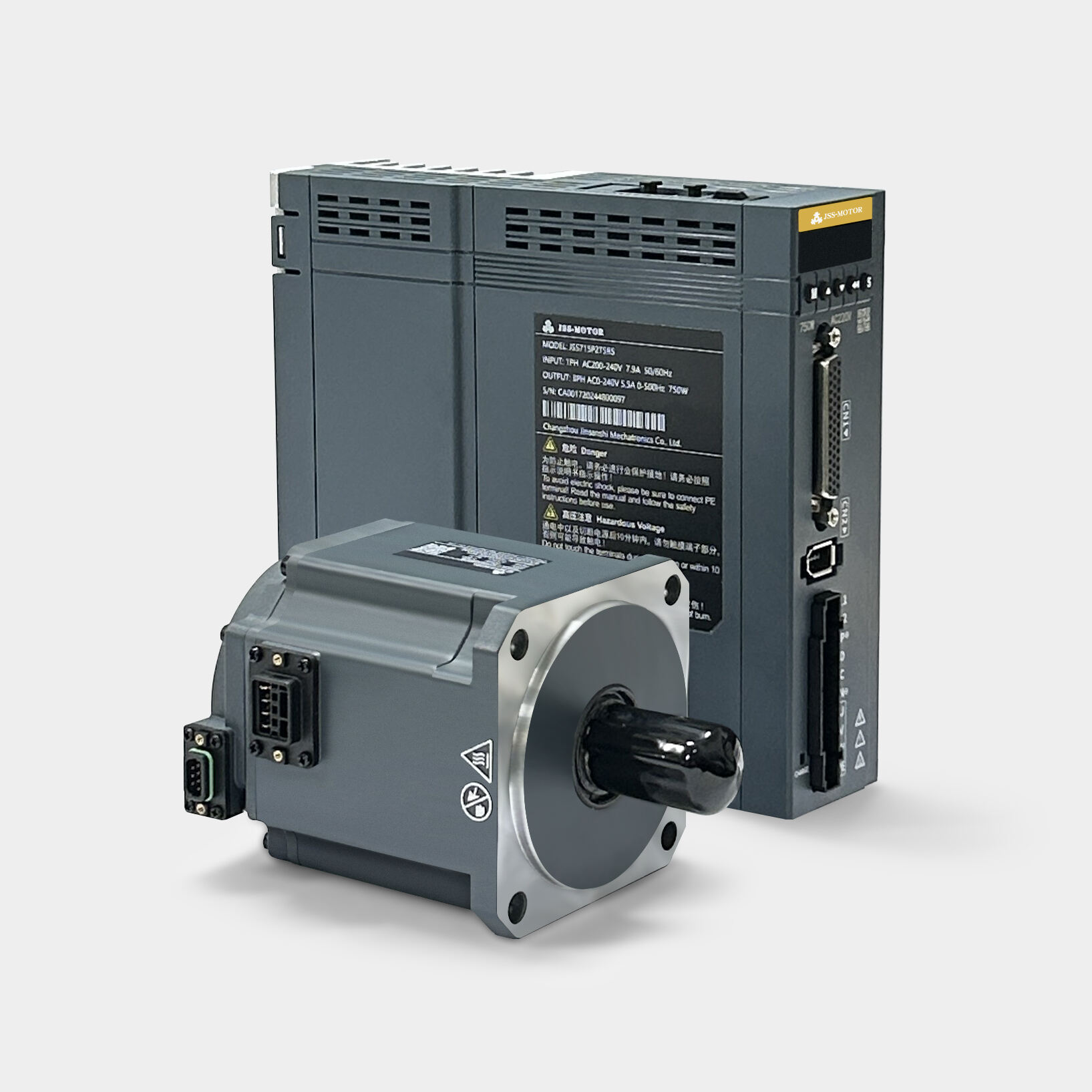
In today's rapidly evolving industrial landscape, precision and control are paramount for achieving optimal performance in automated systems. When applications demand intricate positioning, variable speed control, and exceptional accuracy, engineers consistently turn to servo motor technology as their preferred solution. These sophisticated devices have revolutionized manufacturing processes across industries, from aerospace manufacturing to medical device assembly, by delivering the precise motion control that complex applications require.

The fundamental design principles behind servo motor systems enable them to excel where traditional motors fall short. Unlike standard induction motors that operate at fixed speeds, a servo motor incorporates sophisticated feedback mechanisms that continuously monitor and adjust performance parameters. This closed-loop control system ensures that the motor responds instantly to command signals, making real-time corrections to maintain precise positioning and speed control even under varying load conditions.
Complex motion applications present unique challenges that require advanced motor solutions capable of handling multiple variables simultaneously. These applications often involve multi-axis coordination, rapid acceleration and deceleration cycles, and the need for sub-micron positioning accuracy. Manufacturing processes such as pick-and-place operations, CNC machining, and robotic assembly rely heavily on servo motor technology to achieve the level of precision that modern production demands.
Advanced Control Mechanisms in Servo Motor Technology
Closed-Loop Feedback Systems
The heart of any servo motor system lies in its sophisticated feedback control mechanism. Modern servo motor designs incorporate high-resolution encoders that provide continuous position and velocity feedback to the control system. These encoders can achieve resolutions of thousands of pulses per revolution, enabling positioning accuracy that reaches sub-arc-second levels in many applications.
The feedback loop operates by comparing the actual motor position with the commanded position, generating an error signal that drives corrective action. This continuous monitoring and adjustment process ensures that the servo motor maintains precise control even when external forces attempt to disturb the system. The response time of modern servo motor feedback systems can be measured in microseconds, providing virtually instantaneous correction capabilities.
Advanced servo motor controllers utilize sophisticated algorithms such as PID control, adaptive control, and even machine learning techniques to optimize performance. These controllers can learn from system behavior patterns and automatically adjust parameters to maintain optimal performance as operating conditions change over time.
Dynamic Response Characteristics
The dynamic response capabilities of servo motor systems set them apart from conventional motor technologies. A well-designed servo motor can achieve acceleration rates exceeding 10,000 revolutions per minute per second while maintaining precise control throughout the acceleration and deceleration phases. This exceptional dynamic performance enables complex motion profiles that would be impossible with traditional motor systems.
Servo motor systems excel in applications requiring rapid direction changes, complex trajectory following, and synchronized multi-axis motion. The ability to execute precise motion profiles while maintaining system stability makes servo motor technology indispensable in applications such as semiconductor manufacturing, where nanometer-level positioning accuracy is required.
The torque characteristics of servo motor designs provide consistent performance across the entire speed range. Unlike conventional motors that may experience torque variations at different speeds, servo motor systems maintain constant torque output from zero speed through maximum rated speed, ensuring predictable performance in all operating conditions.
Precision and Accuracy Advantages
Positioning Resolution and Repeatability
Modern servo motor systems achieve positioning resolutions that were unimaginable just decades ago. High-resolution encoders integrated with advanced servo motor designs can provide position feedback with resolutions exceeding one million counts per revolution. This extraordinary resolution translates to positioning accuracy measured in micrometers or even nanometers, depending on the mechanical system design.
Repeatability represents another crucial advantage of servo motor technology in complex applications. Once a servo motor system has been programmed to move to a specific position, it can return to that exact position thousands or millions of times with minimal deviation. This repeatability is essential in manufacturing processes where consistent quality and dimensional accuracy are critical requirements.
The combination of high resolution and excellent repeatability makes servo motor systems ideal for applications such as coordinate measuring machines, laser processing equipment, and precision assembly systems. These applications demand not only accurate initial positioning but also the ability to maintain that accuracy over extended operating periods.
Speed Control and Regulation
Servo motor technology provides exceptional speed control capabilities that extend far beyond simple on-off operation. Modern servo motor systems can maintain speed regulation within 0.01% of the commanded speed, even under varying load conditions. This level of speed control precision is essential in applications such as web processing, where material tension must be maintained within tight tolerances.
The speed control range of servo motor systems typically spans from zero to maximum rated speed with consistent torque output throughout the range. This wide speed range capability enables a single servo motor to handle multiple operating modes within a single application, reducing system complexity and component count.
Advanced servo motor controllers can execute complex speed profiles that include smooth acceleration and deceleration curves, programmable jerk limits, and coordinated motion between multiple axes. These capabilities are essential in applications where mechanical stress must be minimized while maintaining high productivity rates.
Multi-Axis Coordination and Synchronization
Coordinated Motion Control
Complex industrial applications often require precise coordination between multiple motion axes to achieve desired results. Servo motor systems excel in multi-axis applications because they can be synchronized with exceptional precision, enabling coordinated motion that maintains precise relationships between multiple moving components.
Modern servo motor control systems can coordinate dozens of axes simultaneously while maintaining microsecond-level synchronization. This capability is essential in applications such as packaging machinery, where multiple servo motor axes must work together to handle products at high speeds while maintaining precise positioning and timing.
The ability to program complex motion profiles across multiple servo motor axes enables the creation of sophisticated automated systems that can adapt to changing production requirements. These systems can execute different motion patterns for different products without requiring mechanical changes, providing flexibility that is impossible with mechanical cam-based systems.
Electronic Gearing and Cam Functionality
Electronic gearing represents one of the most powerful features of modern servo motor systems. This capability allows multiple servo motor axes to maintain precise speed and position relationships without mechanical coupling. Electronic gearing can be programmed and modified in real-time, providing flexibility that mechanical gearing systems cannot match.
Electronic cam functionality extends the capabilities of servo motor systems even further by enabling the programming of complex, non-linear relationships between axes. This feature allows servo motor systems to replicate the functionality of mechanical cams while providing the flexibility to modify cam profiles through software changes rather than mechanical modifications.
The combination of electronic gearing and cam functionality makes servo motor systems ideal for applications such as packaging machinery, textile equipment, and printing presses, where complex motion relationships must be maintained at high speeds while providing the flexibility to accommodate different product specifications.
Load Handling and Torque Characteristics
Variable Load Compensation
Servo motor systems demonstrate exceptional capability in handling variable load conditions that would cause problems for conventional motor systems. The closed-loop control system continuously monitors motor performance and automatically adjusts drive parameters to maintain consistent performance regardless of load variations.
This load compensation capability is particularly valuable in applications where the load may change during operation, such as material handling systems, robotics, and machine tools. A servo motor can automatically adjust its torque output to maintain constant speed or position accuracy even when external forces vary significantly.
Advanced servo motor drives can even learn load patterns and proactively adjust control parameters to optimize performance for specific applications. This adaptive capability ensures that servo motor systems maintain peak performance throughout their operating life, even as mechanical components age and operating conditions change.
High Torque-to-Inertia Ratio
The design philosophy behind servo motor construction emphasizes achieving the highest possible torque-to-inertia ratio. This characteristic enables rapid acceleration and deceleration while minimizing the energy required for motion control. High torque-to-inertia ratios are essential in applications requiring frequent start-stop cycles or rapid direction changes.
Modern servo motor designs utilize advanced materials and construction techniques to minimize rotor inertia while maximizing torque output. Permanent magnet servo motor designs, in particular, excel in achieving high torque-to-inertia ratios that enable exceptional dynamic performance.
The low inertia characteristics of servo motor systems also contribute to improved system response and stability. Lower system inertia means that control systems can respond more quickly to command changes and disturbances, resulting in better overall system performance and reduced settling times.
Integration with Modern Automation Systems
Communication Protocols and Networking
Modern servo motor systems are designed to integrate seamlessly with contemporary industrial automation networks. Support for advanced communication protocols such as EtherCAT, PROFINET, and Ethernet/IP enables servo motor systems to participate in sophisticated distributed control architectures.
These communication capabilities allow servo motor systems to share real-time performance data with other system components, enabling advanced diagnostic and optimization capabilities. Predictive maintenance algorithms can analyze servo motor performance data to identify potential issues before they result in system downtime.
Network-enabled servo motor systems can also participate in Industry 4.0 initiatives by providing detailed operational data that can be analyzed to optimize production processes and improve overall equipment effectiveness. This connectivity represents a significant advantage in modern manufacturing environments where data-driven decision making is becoming increasingly important.
Programming and Configuration Flexibility
The programmability of servo motor systems provides unprecedented flexibility in motion control applications. Modern servo motor controllers can execute complex motion programs that would require extensive mechanical modifications in traditional systems. This programmability enables rapid changeovers between different products or operating modes without hardware changes.
Advanced programming environments for servo motor systems provide intuitive interfaces that allow engineers to develop, test, and modify motion control programs efficiently. These tools often include simulation capabilities that enable program testing without risking damage to equipment or products.
The ability to store multiple motion programs in servo motor controllers enables automated systems to adapt to different production requirements automatically. Product identification systems can trigger appropriate motion programs, ensuring that each product receives the correct processing without manual intervention.
FAQ
What makes servo motor technology superior to stepper motors in complex applications
Servo motor systems provide closed-loop feedback control that continuously monitors and corrects position and velocity, while stepper motors operate in open-loop mode without feedback. This fundamental difference means that servo motor systems can detect and correct for missed steps, load disturbances, and mechanical variations that would cause stepper motors to lose position accuracy. Additionally, servo motor systems provide higher torque at high speeds, smoother motion, and better dynamic response characteristics essential for complex motion applications.
How do servo motor systems maintain accuracy under varying load conditions
Servo motor systems utilize sophisticated feedback control algorithms that continuously compare actual performance with commanded performance. When load conditions change, the feedback system detects any deviation from the commanded position or speed and automatically adjusts the motor drive signals to compensate. Advanced servo motor controllers can even learn load patterns and proactively adjust control parameters to maintain optimal performance under predictable load variations.
What resolution capabilities can modern servo motor systems achieve
Modern servo motor systems equipped with high-resolution encoders can achieve position feedback resolutions exceeding one million counts per revolution. This translates to positioning accuracy measured in micrometers or even nanometers, depending on the mechanical system design. The actual positioning accuracy depends on factors such as mechanical backlash, thermal stability, and vibration isolation, but properly designed servo motor systems routinely achieve sub-micron positioning accuracy in precision applications.
How do servo motor systems handle multi-axis coordination requirements
Servo motor systems excel in multi-axis applications through advanced motion controllers that can coordinate dozens of axes simultaneously while maintaining microsecond-level synchronization. Electronic gearing capabilities allow multiple servo motor axes to maintain precise speed and position relationships without mechanical coupling, while electronic cam functionality enables complex, non-linear relationships between axes. These capabilities enable sophisticated coordinated motion profiles that adapt to changing production requirements through software modifications rather than mechanical changes.