
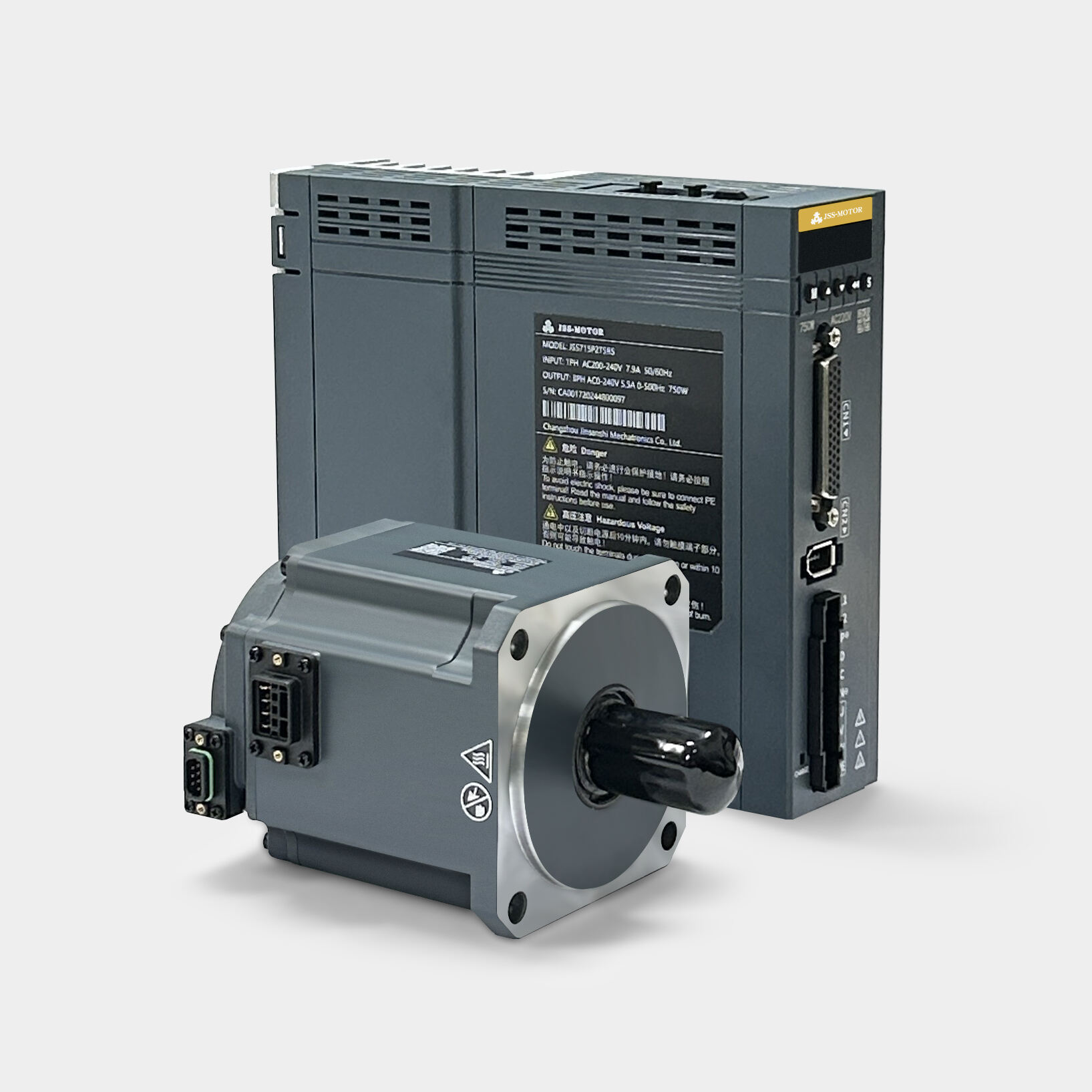
Precision motion control stands as the cornerstone of modern industrial automation, where accuracy determines operational success. In manufacturing environments, robotics applications, and automated systems, the ability to achieve exact positioning and controlled movement separates superior performance from mediocre results. The servo motor emerges as the driving force behind this precision, delivering the exact control needed for demanding applications. Understanding the critical role of feedback systems in servo motor operation reveals why these components have become indispensable in contemporary industrial settings.

Understanding Servo Motor Feedback Systems
The Foundation of Closed-Loop Control
Feedback systems transform a basic servo motor into a precision instrument capable of delivering repeatable accuracy. Unlike open-loop systems that operate blindly, closed-loop servo motor configurations continuously monitor their actual position and compare it against commanded positions. This constant verification process ensures that any deviation from the desired motion profile gets immediately corrected. The feedback mechanism creates an intelligent system that adapts to load variations, environmental changes, and operational demands while maintaining positional accuracy within tight tolerances.
The servo motor feedback loop operates through a continuous cycle of command, execution, measurement, and correction. When a control signal instructs the servo motor to move to a specific position, the feedback device simultaneously tracks the actual movement. Any discrepancy between commanded and actual positions generates an error signal that the servo amplifier uses to adjust motor output. This real-time correction capability enables servo motor systems to achieve positioning accuracies measured in fractions of degrees or micrometers, depending on the application requirements.
Types of Feedback Devices
Modern servo motor systems employ various feedback technologies, each offering distinct advantages for specific applications. Optical encoders represent the most common feedback solution, utilizing light patterns to generate precise position information. These devices provide excellent resolution and accuracy while maintaining reliable operation across diverse environmental conditions. Incremental encoders track relative position changes, while absolute encoders provide exact position information even after power interruptions, eliminating the need for homing procedures.
Resolver-based feedback systems offer exceptional durability in harsh industrial environments where temperature extremes, vibration, and electromagnetic interference might compromise other feedback technologies. The servo motor equipped with resolver feedback maintains accuracy even under challenging conditions that would typically affect optical systems. Magnetic encoders provide another robust alternative, combining good accuracy with resistance to contamination and mechanical shock. Each feedback technology brings specific benefits that make certain servo motor configurations ideal for particular applications.
Critical Role in Motion Accuracy
Achieving Positional Precision
The relationship between feedback quality and servo motor accuracy defines the ultimate performance capabilities of motion control systems. High-resolution feedback devices enable servo motor systems to achieve positioning accuracies that exceed the mechanical tolerances of many applications. Advanced servo motor configurations with 17-bit or higher resolution encoders can distinguish position differences smaller than human hair thickness, making them suitable for precision manufacturing processes like semiconductor fabrication and medical device assembly.
Velocity control represents another critical aspect where feedback systems demonstrate their value in servo motor applications. Smooth velocity profiles require continuous monitoring and adjustment to maintain consistent motion characteristics. The servo motor feedback system tracks not only position but also velocity information, enabling precise speed control even under varying load conditions. This capability proves essential in applications requiring constant surface speeds, synchronized multi-axis motion, or specific acceleration profiles.
Dynamic Response Characteristics
Servo motor feedback systems significantly impact dynamic response characteristics, determining how quickly and accurately the system responds to command changes. High-quality feedback enables faster servo loop update rates, resulting in improved transient response and reduced settling times. The servo motor can react more rapidly to disturbances and command changes while maintaining stability throughout the motion profile. This enhanced responsiveness proves crucial in applications requiring rapid positioning changes or high-frequency motion patterns.
The bandwidth of the servo motor control loop directly correlates with feedback system performance. Advanced feedback technologies support higher control loop frequencies, enabling the servo motor to maintain accuracy even during rapid acceleration and deceleration cycles. This capability becomes particularly important in applications like pick-and-place operations, where cycle time optimization depends on the servo motor's ability to achieve accurate positioning quickly.
Industrial Applications and Benefits
Manufacturing Process Enhancement
Manufacturing industries rely heavily on servo motor feedback systems to achieve the precision required for modern production demands. In CNC machining operations, the servo motor feedback ensures that cutting tools follow programmed paths with microscopic accuracy, resulting in parts that meet tight dimensional tolerances. The continuous position monitoring prevents cumulative errors that could otherwise compromise part quality or require expensive rework. Advanced servo motor systems with integrated feedback enable manufacturers to achieve surface finishes and dimensional accuracies that were previously impossible with conventional motor technologies.
Packaging and labeling operations demonstrate another area where servo motor feedback systems provide substantial benefits. The precise control over conveyor speeds, label positioning, and cutting operations ensures consistent product quality while maximizing throughput. Servo motor systems can automatically adjust for variations in product dimensions, material properties, or line speeds while maintaining accurate registration and positioning. This adaptability reduces waste, improves product quality, and increases overall equipment effectiveness.
Robotics and Automation Systems
Robotic applications showcase the critical importance of servo motor feedback in achieving coordinated multi-axis motion. Industrial robots depend on accurate position feedback from each servo motor to maintain proper tool positioning and follow complex motion paths. The feedback systems enable robots to compensate for mechanical compliance, gear backlash, and thermal expansion while maintaining precise end-effector positioning. Modern servo motor technology with advanced feedback capabilities allows robots to perform delicate assembly operations, precision welding, and intricate material handling tasks.
Collaborative robots represent an emerging application where servo motor feedback systems enable safe human-robot interaction. The precise torque and position control made possible by advanced feedback allows these systems to detect unexpected contact and respond appropriately. The servo motor can instantly adjust its behavior based on feedback information, ensuring both operational accuracy and personnel safety in shared workspaces.
Technological Advancements in Feedback Systems
Digital Communication Protocols
Modern servo motor feedback systems increasingly incorporate digital communication protocols that enhance accuracy and reduce electromagnetic interference. EtherCAT, PROFINET, and other industrial Ethernet protocols enable high-speed, deterministic communication between servo motor feedback devices and control systems. These digital protocols eliminate the analog signal degradation that can affect traditional feedback systems while providing additional diagnostic and monitoring capabilities that enhance system reliability.
The integration of digital feedback protocols allows servo motor systems to provide comprehensive operational data beyond basic position information. Temperature monitoring, vibration analysis, and predictive maintenance capabilities become possible when feedback systems incorporate intelligent communication features. This additional information enables proactive maintenance strategies and helps optimize servo motor performance throughout the equipment lifecycle.
Enhanced Resolution and Accuracy
Contemporary feedback technologies continue pushing the boundaries of servo motor accuracy through increased resolution and improved signal processing. Multi-turn absolute encoders with 25-bit resolution enable servo motor systems to track position through thousands of rotations while maintaining sub-arc-second accuracy. Advanced interpolation techniques multiply the effective resolution of feedback signals, allowing servo motor systems to achieve positioning accuracies that approach the mechanical limits of the driven systems.
Temperature compensation and environmental adaptation represent additional areas where modern feedback systems enhance servo motor performance. Intelligent feedback devices automatically adjust their output characteristics to compensate for thermal effects and environmental variations. This capability ensures that servo motor accuracy remains consistent across varying operating conditions, reducing the need for frequent recalibration and maintaining system performance throughout extended operating periods.
Future Trends and Developments
Integration with Industry 4.0 Technologies
The evolution of servo motor feedback systems aligns closely with Industry 4.0 initiatives that emphasize connectivity, data analytics, and intelligent automation. Future feedback systems will incorporate edge computing capabilities that enable local data processing and decision-making within the servo motor system itself. This distributed intelligence will reduce communication latency while providing sophisticated motion control capabilities that adapt to changing operational requirements automatically.
Machine learning algorithms integrated into servo motor feedback systems will enable predictive control strategies that anticipate load changes and environmental variations. These intelligent systems will continuously optimize servo motor performance parameters based on historical data and real-time conditions, resulting in improved accuracy, reduced energy consumption, and extended equipment life. The servo motor will evolve from a reactive system to a proactive component that contributes to overall system optimization.
Miniaturization and Integration
Ongoing developments in sensor technology and electronics packaging continue to reduce the size and cost of servo motor feedback systems while improving their performance characteristics. Integrated feedback solutions that combine position sensing, communication interfaces, and signal processing within compact packages enable servo motor designs that were previously impractical due to space constraints. These miniaturized systems maintain full accuracy and functionality while reducing installation complexity and system costs.
Wireless feedback technologies represent an emerging trend that could revolutionize certain servo motor applications. Battery-powered wireless encoders eliminate the need for feedback cables in rotating applications, reducing maintenance requirements and enabling servo motor installations in previously inaccessible locations. While still in development stages, wireless feedback systems show promise for specific applications where traditional wired feedback systems face installation or maintenance challenges.
FAQ
What happens when servo motor feedback fails?
When servo motor feedback fails, the system loses its ability to verify actual position against commanded position, typically resulting in either system shutdown for safety or erratic motion behavior. Most modern servo amplifiers include fault detection mechanisms that immediately stop servo motor operation when feedback signals are lost or corrupted. This protective response prevents potential damage to equipment or workpieces that could result from uncontrolled motion. Backup feedback systems or redundant encoders in critical applications provide continued operation even when primary feedback devices fail.
How does feedback resolution affect servo motor performance?
Feedback resolution directly impacts the smallest position increment that a servo motor system can detect and control. Higher resolution feedback devices enable finer position control and improved accuracy, particularly important in precision applications like medical equipment or semiconductor manufacturing. However, increased resolution must be balanced against system bandwidth and processing capabilities, as higher resolution typically requires more sophisticated control algorithms and faster processing speeds to maintain optimal servo motor performance.
Can servo motor feedback systems operate in harsh environments?
Servo motor feedback systems can indeed operate in harsh environments when properly selected and protected. Resolver-based feedback systems offer excellent resistance to temperature extremes, vibration, and electromagnetic interference. Sealed optical encoders with appropriate ingress protection ratings withstand exposure to moisture, dust, and chemical contaminants. The key lies in matching the feedback technology to the specific environmental challenges while providing adequate protection through proper enclosure design and installation practices.
What maintenance do servo motor feedback systems require?
Servo motor feedback systems typically require minimal maintenance when properly installed and protected. Regular inspection of cable connections, cleaning of optical windows on encoders, and verification of mounting hardware represent the primary maintenance activities. Advanced feedback systems with diagnostic capabilities provide early warning of potential issues, enabling proactive maintenance before failures occur. Proper environmental protection and adherence to manufacturer installation guidelines significantly extend feedback system life and reduce maintenance requirements.